

Did you know that 10,500 websites are created hourly, and it takes only 0.05 seconds for users to decide whether your website is good enough or not? And in 2026, that moment matters more than ever. Buyers are smarter, competition is fiercer, and a poorly built store will bleed money before it even starts. If you’re serious about starting an e-commerce business in 2026, here’s the no-fluff roadmap you actually need. Whether you’re looking for a custom website development company for small businesses or planning to build it yourself, this guide walks you through every step that moves the needle.
→ Explore Our E-commerce Website Development Services
Why Your E-commerce Website Structure Can Make or Break Sales
This section breaks down how e-commerce website structure best practices directly affect your conversion rate, search visibility, and how users navigate your store. Getting this right at the start saves you from expensive redesigns later. Think of it as laying the right foundation before you build the house. Skip it, and everything else becomes much harder.
How to Plan a Site Architecture That Actually Converts
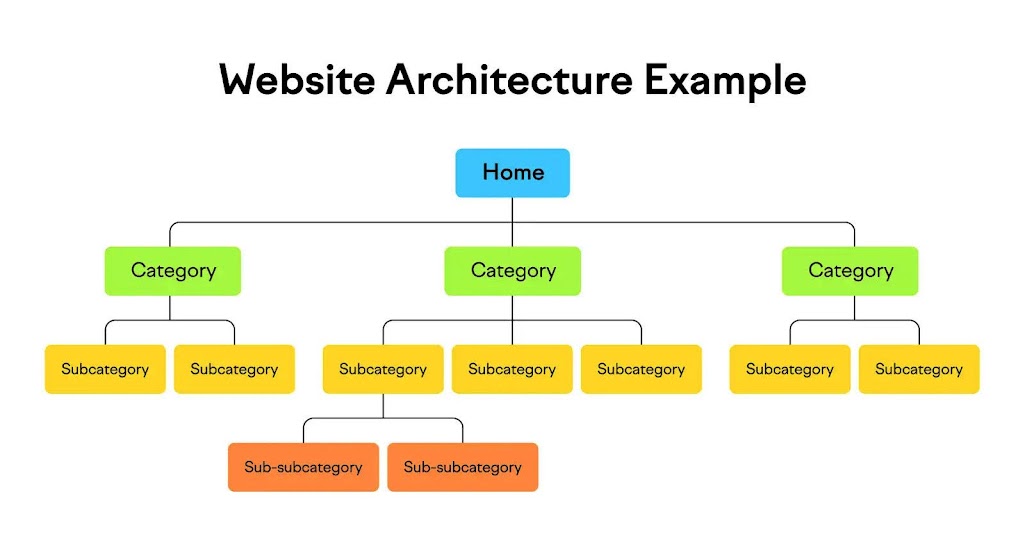
Image Source: Semrush
Good architecture isn’t just about looking organized. It’s about guiding visitors from the homepage to the checkout in the fewest steps possible. When your site hierarchy is clean and logical, both users and search engines trust it more. Here’s what a solid e-commerce site architecture looks like and why it matters.
- Keep your homepage at the top and branch into clean, clearly named categories below it. Don’t get creative with category names. Clarity wins over cleverness every time.
- Limit depth to 3 clicks from the homepage to any product page. Deeper than that, and both users and crawlers start dropping off.
- Use subcategories logically so someone browsing ‘Men’s Shoes’ can immediately find ‘Running Shoes’ or ‘Formal Shoes’ without hunting.
- Avoid orphan pages; every page should be reachable from at least one internal link, or it’s essentially invisible.
- Name your URLs descriptively; ‘yourstore.com/mens-running-shoes’ will always outrank ‘yourstore.com/prod?id=4491’ in search and in trust.
Recommended E-commerce Site Architecture
| Level | Page Type | Example |
| Level 0 | Homepage | yourstore.com |
| Level 1 | Main Categories | yourstore.com/womens-clothing |
| Level 2 | Subcategories | yourstore.com/womens-clothing/tops |
| Level 3 | Product Pages | yourstore.com/womens-clothing/tops/floral-kurta |
The 3-Click Rule And Why It Matters In 2026
There’s a well-known guideline in web design: no page should be more than 3 to 4 clicks away from your homepage. This isn’t just about user convenience; it’s about crawler efficiency too. The further a page is buried, the less link equity it receives, which means lower rankings.
The image below (reference your second uploaded diagram) illustrates two architectures side by side.
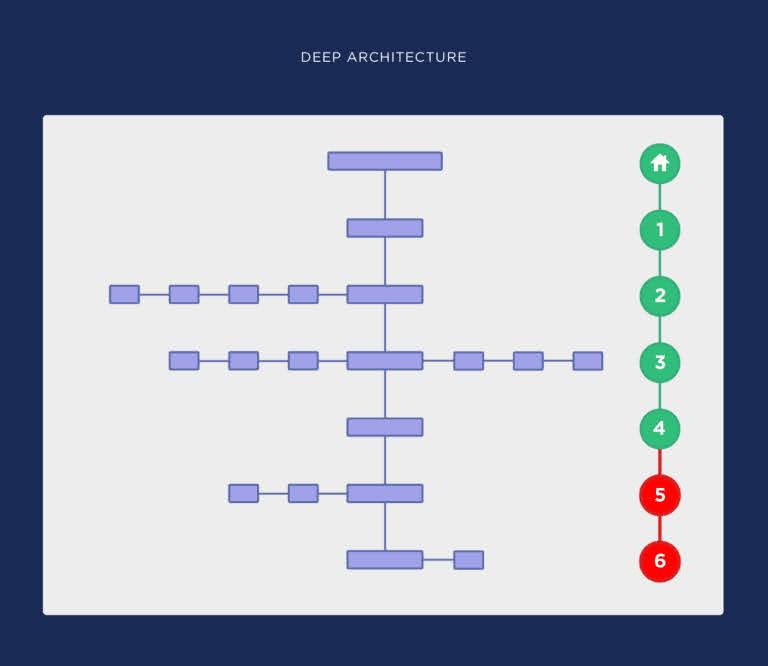
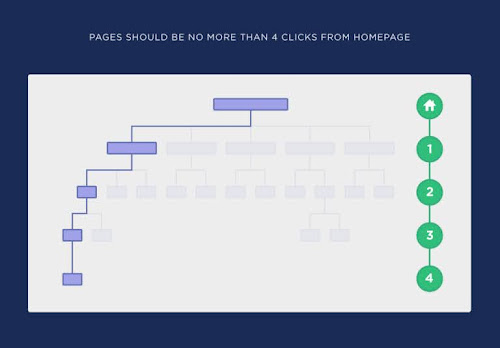
Image Source: Backlinko
The left shows a healthy flat structure where all pages are accessible within 4 clicks. The right shows a deep architecture where some pages fall 5 or 6 clicks deep; those nodes turn red because they’re effectively invisible to both users and search engines.
- Flat structures distribute link equity evenly across all pages, boosting SEO across the board.
- Deep structures leave bottom-level pages starved of authority. They rank poorly and get crawled infrequently.
- Navigation menus are your shortcut: A well-structured mega menu can effectively flatten even a very large catalogue.
- Breadcrumbs help users backtrack without frustration and reinforce your hierarchy for search engines.
- Pro tip: Keep every page at a maximum of 3 to 4 clicks from your homepage to ensure both visitors and crawlers can easily access all your webpages.
→ View Our E-commerce Services
Shopify vs Custom Build: Picking the Right Platform for Your E-commerce Business in 2026

Choosing your platform is one of those decisions that feels easy until you’re stuck three months in with a system that doesn’t do what you need. This part of the e-commerce website development guide helps you navigate that decision honestly. It’s not just about cost. It’s about scalability, flexibility, and what your business actually needs right now versus six months from now.
When Shopify Is the Smart Choice (And When It Isn’t)
Shopify is genuinely brilliant for a lot of things. It’s fast to launch, built for selling, and has an enormous ecosystem of apps. But it also has real limitations, especially if you need complex customization or have a niche business model. A good Shopify e-commerce website development company will tell you this upfront rather than just taking the project.
- Choose Shopify if you’re a product-first business with standard selling flows, a reasonable budget, and a need to launch fast.
- Go custom if your business logic is complex, if you need deep integrations like ERP or custom CRM, or if you need total control over UX.
- Shopify’s AI features in 2026, including Sidekick (their built-in AI assistant) and predictive product recommendations, are genuinely useful for smaller stores.
- Transaction fees on Shopify can quietly eat into margins at scale. Always factor them in upfront before committing.
- Headless commerce is growing fast: If you want Shopify’s backend but a fully custom frontend, a good development partner can set that up for you.
Platform Comparison: Shopify vs Custom vs WooCommerce (2026)
| Feature | Shopify | Custom Build | WooCommerce |
| Time to Launch | 2-6 weeks | 8-20 weeks | 4-10 weeks |
| Customization | Moderate | Total Freedom | High (with dev) |
| Payment Integration | Built-in apps | Any gateway | Plugin-based |
| Scalability | Very good | Unlimited | Server-dependent |
| Ongoing Cost | Monthly fees + apps | Hosting and maintenance | Low base cost |
| AI Features (2026) | Native Sidekick AI | Custom AI integrations | Plugin-dependent |
| Best For | Product-first SMBs | Complex, unique businesses | WordPress-based stores |
How To Evaluate Payment Integration Before You Build
Payment integration is one of those things people treat as an afterthought. But it directly influences your conversion rate. A checkout that adds friction, asks for too much, or doesn’t support preferred payment methods will cost you real sales. So evaluate this early, before you pick a platform, not after.
- Multi-gateway support is non-negotiable if you’re selling internationally. Razorpay, Stripe, PayPal, and UPI all serve very different audiences.
- One-click checkout (available natively on Shopify via Shop Pay) can meaningfully reduce cart abandonment, particularly on mobile.
- Buy-Now-Pay-Later (BNPL) options like Afterpay or ZestMoney are increasingly expected by younger buyers in 2026.
- PCI-DSS compliance matters: Verify your platform and your payment processor both meet current security standards before going live.
WooCommerce vs. Shopify: Which one is better for your online store?
E-commerce Website Design for Conversions: What Actually Moves the Needle
You can have the best products in the world. But if your website looks untrustworthy, loads slowly, or confuses people, they’ll leave in seconds. E-commerce website design for conversions is a whole discipline in itself, and it’s worth taking seriously. Every visual and UX choice either builds trust or breaks it. There is no neutral design.
Design Elements That Build Trust Instantly
Trust is the underlying currency of e-commerce. Before someone hands over their card details, they need to feel confident that your store is legitimate, your products are good, and their data is safe. These design choices communicate that without saying a word.
- High-resolution product imagery with multiple angles and a zoom feature. In 2026, buyers expect 3D or 360-degree views for higher-ticket items.
- Display trust badges at checkout, such as an SSL lock, payment logos, and money-back guarantees. Don’t hide them. Place them where the eye naturally goes.
- Social proof near the buy button, like a star rating, number of reviews, or a ‘200+ sold this week’ nudge, works better than any copywriting.
- Consistent branding across every page: Inconsistent fonts, colors, and spacing signal an unprofessional store and erode confidence quickly.
- Mobile-first design is table stakes: Over 70% of e-commerce traffic in India is mobile. If it doesn’t work perfectly on a phone, it’s a major flaw.
Typography, Color, And Layout That Sell
These might sound like aesthetic concerns, but they have a measurable impact on conversion. Color psychology is real. Hierarchy in typography guides the eye to what matters. And layout determines whether someone reaches the add-to-cart button or gets distracted and leaves before they get there.
- High-contrast CTAs: Your ‘Add to Cart’ or ‘Buy Now’ button should never compete visually with anything else on the page. Make it pop.
- Whitespace is not wasted space: It lets the eye breathe and focuses attention on what matters, particularly your product and price.
- F-pattern and Z-pattern reading: Most users scan pages in these patterns. Design your layouts so key information sits in these natural eye paths.
- Font hierarchy matters: Bold product name, clear price, short benefit statement, then CTA. This sequence is proven and predictable.
13 eCommerce Trends You Should Absolutely Be Aware Of
E-commerce Website Development: Getting Payment Integration and Tech Stack Right

Most e-commerce tutorials gloss over the technical infrastructure too quickly. Getting payment integration and backend setup right means fewer failed transactions, less fraud risk, and a smoother customer experience from checkout to delivery confirmation. Whether you’re working with a Shopify e-commerce website development company or building a custom store, your technical setup will define how well the business scales.
Setting Up Payments That Don’t Lose You Sales
The checkout is the last hurdle between a buyer’s intent and your revenue. Every friction point here costs you real money. Investing in good e-commerce website development services that provide a good payment integration system means thinking through the complete journey, not just plugging in a gateway and calling it done.
- Integrate multiple payment options from day one: Credit/debit cards, UPI, net banking, and wallets (Paytm, PhonePe), and BNPL should all be available, depending on your audience.
- Test the checkout flow on every device before launch: Payment failures are often device- or browser-specific, and they’re devastating if discovered post-launch.
- Enable guest checkout: Requiring customers to create an account before checkout is the number one reason for cart abandonment, particularly for first-time customers.
- Smart error messages at checkout: Tell users exactly why a transaction failed and what to do. ‘Transaction declined’ tells them nothing, and they leave.
- Auto-fill and saved cards with tokenization make it easier for repeat customers and are expected to be the norm in 2026.
Performance, Hosting, And Security Basics You Can’t Skip
Page speed is directly related to conversion rate. According to Google’s own research, a one-second delay in mobile page load times can result in a conversion rate decrease of up to 20%. Now, when you factor in security and compliance, these technical issues become business-critical decisions, not afterthoughts that you worry about later.
- Core Web Vitals are a Google ranking factor: Aim for LCP under 2.5 seconds, CLS below 0.1, and INP under 200 ms.
- An SSL certificate is mandatory, no exceptions. Browsers now flag non-HTTPS sites aggressively, and customers will bounce immediately.
- Image optimization with the WebP format and lazy loading is a simple win that most stores skip. It can cut page size by 40 to 60%.
- Regular security audits matter: SQL injection, CSRF, and XSS vulnerabilities are still common attack vectors for e-commerce stores.
Google Merchant Center: Everything eCommerce Sellers Need to Know
E-commerce Conversion Optimization Tips That Are Actually Working in 2026
Getting traffic to your e-commerce store is only half the battle. Turning that traffic into paying customers—that’s where the real game is played. This is what conversion optimization is all about. The tips in this section are grounded in what’s currently working across stores of different sizes and niches, not theoretical ideas pulled from outdated case studies.
Product Page Optimization: Where Most Conversions Are Won or Lost
The product page is your most important real asset. It’s where intent meets decision. Everything on this page either removes hesitation or adds to it. When you’re building a high-converting e-commerce website, the product page is where most of the work actually lives.
- Lead with the transformation, not the feature; for example, ‘Sleeps cooler in summer’ beats ‘Made with breathable bamboo fiber’ for non-technical buyers every single time.
- Video content on product pages increases conversions significantly. A 15-second video showing the product in use is worth more than ten static images.
- Show real customer photos in your review section, not just star ratings. Authenticity builds more trust than polish.
- Urgency and scarcity signals, like ‘Only 4 left’ or ‘Selling fast,’ work if they’re real. Fake scarcity gets noticed and destroys trust permanently.
- Contextual cross-sells (not random ‘you might also like’) lift average order value without annoying the buyer.
Checkout Optimization: The Last Conversion Battlefield
About 70% of shoppers who add something to their cart don’t complete the purchase. That’s not a small problem; that’s the biggest leak in your funnel. Most of those abandonments happen because the checkout creates friction, uncertainty, or doubt. Here’s how to close that gap.
-
- Progress indicators in multi-step checkouts reduce abandonment. People need to see they’re almost done.
- Cart abandonment emails sent at 1 hour, 24 hours, and 72 hours post-abandonment can recover 5 to 15% of abandoned carts.
- Display shipping costs early; surprise shipping fees at checkout are the single biggest reason for abandonment globally.
- A/B test your CTA buttons like ‘Complete Purchase,’ which outperforms ‘Submit Order’ in most tested contexts because it simply sounds more positive.
Top eCommerce Marketing Strategies You Should Consider for Your Online Store
Why Working with an E-commerce Website Development Company in Mohali Makes Business Sense
At some point, you have to decide: build this yourself, piece it together with freelancers, or work with a proper e-commerce development team. This decision will define your timeline, your budget, and the quality of what you end up with. As a dedicated e-commerce website development company in Mohali, we’ve built stores for startups and growing brands across India, and we know what it takes to actually move sales numbers, not just launch a pretty website.
What to Look for in an E-commerce Development Partner
Not every agency that builds websites is equipped to build e-commerce stores that perform. The gap between a ‘website that works’ and a ‘website that converts’ is enormous. It’s filled with experience, testing, and commercial thinking. Here’s what to look for before you sign anything.
- Real ecommerce experience, not just web design: Ask to see live stores they’ve built and actual conversion metrics or case study results.
- Full-stack capability: Design, development, payment integration, performance optimization, and post-launch support should all be managed properly.
- They ask about your business goals before they talk about technology: An agency that leads with ‘we’ll build it on [platform]’ before understanding your business is a red flag.
- Transparent pricing and timelines: E-commerce projects with vague scopes always balloon. Insist on a detailed Statement of Work upfront.
- SEO and performance thinking from day one: Retrofitting these after launch is expensive. A good team builds them in from the start.
Why A Local Partner In Mohali Can Serve You Better
There’s a real advantage to working with an agency that understands the Indian e-commerce landscape, including local payment behaviors, logistics integrations, tax compliance, and the cultural nuances of most buyers’ trust signals. A custom website development company for small businesses based in Mohali brings that contextual knowledge, combined with world-class development capability.
- Time zone alignment means faster communication, quicker iterations, and no 3 AM stand-ups for your team.
- Understanding of Indian payment gateways (Razorpay, CCAvenue, and PayU) and their nuances is built-in experience, not knowledge Googled for your project.
- Knowledge of India-specific regulations, like government guidelines on recurring payments, data localization, and tax invoicing, is practical and current.
- Post-launch support in the same timezone means issues get resolved in hours, not days.
Your E-commerce Journey Starts With One Good Decision
Building a high-converting e-commerce website in 2026 isn’t about doing a hundred things right. It’s about doing the fundamentals exceptionally well: clean architecture, the right platform, trustworthy design, smooth payments, and relentless optimization. Every piece connects. Skip one, and the whole chain weakens.
The good news? None of this is out of reach. Whether you’re a first-time founder or an established brand moving online, the playbook is clearer than it’s ever been. What separates stores that thrive from stores that struggle is rarely luck. It’s judgment, planning, and the right team behind you.
If you’re looking for experienced e-commerce website development services in Mohali to help you build something that actually performs, let’s start a conversation. The best time to get this right is before you build, not after.
External Resources
- What is Global E-commerce? Trends and How to Expand Your Operation (2026)
- Baymard Institute: Cart & Checkout Usability Research
Also Read
- Here’s Why PPC is Crucial for Your E-commerce Store
- How To Make an eCommerce App Like Amazon: Features, Business Model & Cost
Tags
#EcommerceWebsite #ShopifyDevelopment #ConversionOptimization #WebDevelopmentMohali #Ecommerce2026
FAQs
1. How much does it usually cost to build an e-commerce website today?
It really depends on what you’re building. A basic Shopify store can be relatively affordable, while a fully custom website with advanced features and integrations will need a larger investment.
2. What are the main steps involved in building a good e-commerce website?
Start with clear planning and site structure, choose the right platform, focus on conversion-friendly design, set up secure payments, optimize performance, and test everything before going live.
3. Is e-commerce still a profitable business in 2026?
Yes, but success isn’t automatic. Profitability comes from smart positioning, great user experience, strong marketing, and continuously improving how your store converts visitors into buyers.
4. What does the 80/20 rule mean in e-commerce?
It usually means that a small percentage of your products or customers generates most of your revenue. Knowing what works best helps you focus your time and resources more effectively.
5. What makes an e-commerce website actually successful?
Clear navigation, trustworthy design, fast performance, and a smooth checkout process are some of the biggest factors that influence whether visitors become customers.
6. How much investment do you need to start an e-commerce business in India?
There’s no fixed number; costs vary based on inventory, marketing, platform choice, and development needs. Many businesses start lean and scale gradually as sales grow.
7. Should I choose Shopify or go for a custom-built website?
If you want a faster launch with standard selling features, Shopify is often a good choice. Custom development works better if you need advanced functionality or unique workflows.
8. Why does website structure matter so much for e-commerce?
A clean structure helps users find products quickly and also makes it easier for search engines to understand your site, which improves visibility and conversions.
9. What is the 3-click rule everyone talks about?
It’s the idea that users should reach any important page within three or four clicks from the homepage. Keeping navigation simple reduces frustration and improves engagement.
10. Which payment options should an online store offer in India?
Most stores benefit from supporting UPI, credit/debit cards, net banking, wallets, and buy-now-pay-later options so customers can choose what feels easiest.
11. Is mobile optimization really that important now?
Absolutely. A large percentage of shoppers browse and buy on their phones, so your website needs to load fast and work smoothly on smaller screens.
12. What design choices help build trust instantly?
High-quality product images, real customer reviews, consistent branding, clear policies, and visible security badges all make shoppers feel more confident.
13. How can I reduce cart abandonment on my website?
Simplify checkout steps, allow guest checkout, show shipping costs early, and use follow-up emails to remind customers who leave before completing their purchase.
14. Why work with a professional e-commerce development company instead of building everything yourself?
A good team helps you avoid common mistakes, builds with scalability in mind, and focuses on real business results, not just how the website looks.
15. How can I contact 42Works for e-commerce website development help?
You can reach out by emailing contact@42works.net or calling +91-9517770042 to discuss your project and explore the right approach.