

Most businesses are sitting on a goldmine they keep ignoring. That corporate explainer video? That product demo? That founder’s interview? They all could be performing. But right now, they are just sitting there, getting no clicks and no conversions. The good news is that converting a generic video into a high-converting ad is not magic. It is a strategy. And if you are working with the right video marketing agency, the transformation can happen faster than you think.
Whether you are targeting audiences on Meta, YouTube, LinkedIn, or Instagram Reels, the rules for what actually converts have shifted dramatically heading into 2026. This blog breaks it all down, section by section.
Explore Our Digital Marketing Services
Get the Ultimate Digital Marketing Checklist. Download Now! 👇
42Works’ Complete Digital Marketing Checklist
Why Generic Videos Fail and What the Data Actually Says
Before diving into fixes, it helps to understand why generic videos underperform. The problem is rarely the production quality. It is the lack of intentional design. Platforms like Meta now use AI-driven delivery systems that reward viewer retention, engagement rate, and click-through behavior. If your video does not trigger those signals early, it simply does not get shown. Here is what you need to know to change that, starting with the hook.
The Hook Problem: You Are Losing People in the First 3 Seconds

The hook is the most critical and most underbuilt part of any video ad. Most generic videos open with a logo or a slow pan over a product. That is a conversion killer. On Meta and YouTube in 2026, you need a pattern interrupt in the very first frame. Here is what a strong hook actually looks like across platforms:
- Lead with a provocative question or a bold statement that challenges a common belief your audience holds.
- Show the result or end state first, then walk backwards to the problem, creating an instant curiosity gap.
- Use text overlays in the first frame because 85% of Facebook video is watched on mute, and that number is not shrinking.
- For YouTube pre-roll, front-load your value proposition before the “Skip Ad” button appears at five seconds.
- Use real faces and genuine emotion in the first frame. Human faces activate mirror neurons and delay the scroll.
Platform-Specific Hook Differences You Should Know
A hook that works on YouTube will not always land on Meta or TikTok. Each platform has its own content culture and user intent, and your hook needs to match it. Getting this wrong is one of the most common reasons well-produced videos underperform after being repurposed across channels.
- YouTube Shorts and long-form pre-roll require different approaches: Shorts need an instant payoff; pre-roll needs a bold claim before the second five.
- Meta (Facebook and Instagram) rewards native-looking content. Overly polished ads often get flagged mentally as ads and skipped.
- LinkedIn video performs best when it opens with a professional insight or an industry pain point specific to a job title.
- Instagram Reels hooks must be visual and kinetic. Movement in the first frame increases watch time significantly.
- X (formerly Twitter) video should hook with text-driven curiosity since users on that platform are in a reading mindset.
PRO TIP: TEST 3 DIFFERENT HOOKS ON THE SAME VIDEO BODY
Reference Article
WordStream: How to Hook Your Audience in the First Seconds of a Video Ad
Also Read:
Everything You Need to Know About the Fundamentals of PPC
Once you have fixed the hook, the next challenge is keeping people watching. Retention is the new reach. This is especially true on YouTube, where watch time directly influences whether your content or ads get pushed to more people.
On Meta, videos with strong mid-section engagement generate lower CPMs because the algorithm rewards content that keeps people on the platform. Understanding how to structure the body of your video is just as important as nailing the opening.
Video Structure That Actually Holds Attention Through the Middle
The middle of a video is where most generic videos fall apart. They tend to follow a predictable, information-dump format: here is our product, here is what it does, and here is why it is good. Audiences are numb to that. A well-structured video ad, built by a capable digital marketing company, uses a completely different flow that borrows from storytelling and behavioral psychology.
The PAS Framework and Why It Still Works in 2026
Problem, Agitate, Solve (PAS) has been around in copywriting for decades, but it translates beautifully to video when executed properly. It is not about manipulation. It is about putting the audience’s real experience at the center of your story and then showing up as the answer. Here is how to apply it to video specifically:
- Problem: Name the specific pain clearly. Not vague frustration, but a moment or scenario your viewer has actually lived through.
- Agitate: Make it real. Show the consequences of not solving the problem. Emotion drives retention more than information does.
- Solve: Introduce your product or service as the natural outcome of the journey you just walked the viewer through.
- Proof: Follow the solution with a data point, a testimonial clip, or a before-and-after visual to anchor the claim.
- CTA: Close with one clear instruction, not three. Ambiguous endings kill conversions.
Video Length by Platform and Objective in 2026
Length is not a one-size-fits-all decision. It depends on the platform, funnel stage, and content type. Choosing the wrong length means you either lose people before your CTA or you pad the video with filler that destroys credibility. Here is a clear breakdown:
| Platform | Ad Objective | Recommended Length | Key Rule |
|---|---|---|---|
| Meta (Facebook) | Awareness | 6-15 seconds | Mobile-first, caption everything |
| Meta (Instagram) | Conversions | 15-30 seconds | Native-looking UGC style |
| YouTube Pre-roll | Awareness | 15-30 seconds | Value prop before 5 seconds |
| YouTube In-stream | Consideration | 2-5 minutes | Story-driven retention curves |
| LinkedIn Video Ads | Lead Gen | 30-90 seconds | B2B pain points, credibility first |
| TikTok / Reels | Awareness + Clicks | 7-20 seconds | Trend-native, movement-first |
QUICK RULE: MATCH VIDEO LENGTH TO WHERE THE VIEWER IS IN THE FUNNEL
Reference Article
HubSpot: Video Marketing Statistics That Will Shape Your Strategy
Also Read:
PPC Fundamentals You Need to Know
Here is something that a lot of brands skip entirely: repurposing. Most businesses shoot a video once and use it in one format on one platform. That is leaving enormous performance on the table. Knowing how to convert generic videos into high-converting ads is often as much about smart repurposing as it is about reshooting. A single three-minute brand film can become six to eight distinct ad assets if you know what you are doing.
The Repurposing Framework That Turns One Video into Eight Ad Assets

Repurposing is not just chopping a long video into short clips. That is the lazy version, and it rarely works. Strategic repurposing means extracting the best moments and reframing them for each platform’s native format, and adapting the message for different audience segments. This is where a smart digital marketing solutions partner earns its value. Here is how to think about it.
How to Identify the Gold Clips in Any Generic Video
Not every part of a video deserves to be amplified. Before you start cutting and repurposing, you need to audit your existing footage for what actually has potential. There are signals you can look for, even without platform analytics, that tell you which moments will perform.
- Look for moments where someone says something surprising, counterintuitive, or emotionally resonant. These are natural hooks.
- Identify any moment that includes a specific result, number, or measurable outcome. Social proof clips perform exceptionally well.
- Pull out the “aha” moment, the part of the video where the viewer’s understanding shifts. That is often the best middle-of-funnel content.
- Find any moment with genuine human emotion: laughter, frustration, or relief. Emotion drives sharing and saves.
- Clip any segment where your product is shown solving a problem in real time, not being described, but actually shown working.
The 8-Asset Repurposing Map for One Source Video
Once you have identified your gold clips, you can build out a full content ecosystem from a single video. This is what any serious video marketing agency should be doing for their clients. Most brands do not do this and end up producing five times as much content as they need to.
- Asset 1: Full version for YouTube long-form or LinkedIn native upload (3 to 5 minutes).
- Asset 2: 60-second cut for Facebook feed and Instagram feed ads.
- Asset 3: 15-second hook clip for YouTube pre-roll and Instagram Stories.
- Asset 4: Vertical Reels/Shorts cut (9:16 format) with captions for Meta and YouTube Shorts.
- Asset 5: Text-overlay social proof clip (testimonial or result moment) for retargeting campaigns.
- Asset 6: Still frame or GIF with a quote for use as a paid image carousel ad.
- Asset 7: Audio-only clip repurposed for podcast advertising or Spotify audio ads.
- Asset 8: Blog embed version with transcript used to boost SEO and organic reach.
THINK OF YOUR SOURCE VIDEO AS RAW MATERIAL, NOT THE FINAL PRODUCT
Reference Article
Sprout Social: How to Build a Video Content Strategy That Works
Captions, text overlays, and subtitles are not optional. They are conversion tools. Studies consistently show that video ads with captions generate significantly higher view-through rates and lower drop-off rates, especially on mobile. And yet, the majority of videos running on Meta and YouTube right now still have no captions at all. If you are working with a digital marketing company that is not making captions a default part of every video asset, that is worth a conversation.
Captions, Text Overlays, and Visual Design That Actually Convert
The visual layer of your video, including everything layered on top of the footage itself, is a massively underutilized conversion lever. On-screen text, animated subtitles, graphic callouts, and strategic end screens all influence whether someone clicks or keeps scrolling. This is an area where the best digital marketing services in Chandigarh and globally are now investing heavily, and the ROI is visible. Here is what to know.
The Caption Strategy That Top-Performing Ads Will Use in 2026
There is a difference between auto-generated captions and strategically designed caption systems. Platforms like Meta and YouTube offer auto-captioning, but auto-captions are often inaccurate and not optimized for readability or emphasis. Building your own caption system gives you creative and conversion control.
- Use kinetic captions (animated word-by-word subtitles) for Reels and Shorts. They increase retention by making the content feel faster and more dynamic.
- Highlight key power words in a contrasting color or bolder font within your caption system. Emphasis guides attention.
- Keep caption fonts large enough to read on a phone screen held at arm’s length. If it requires squinting, it is too small.
- For Facebook and Instagram feeds, always burn in captions directly into the video file so they appear even when auto-captions are turned off.
- Include the brand name or a value-reinforcing phrase in the first caption that appears on screen, not just at the end.
Text Overlays That Drive Clicks, Not Just Views
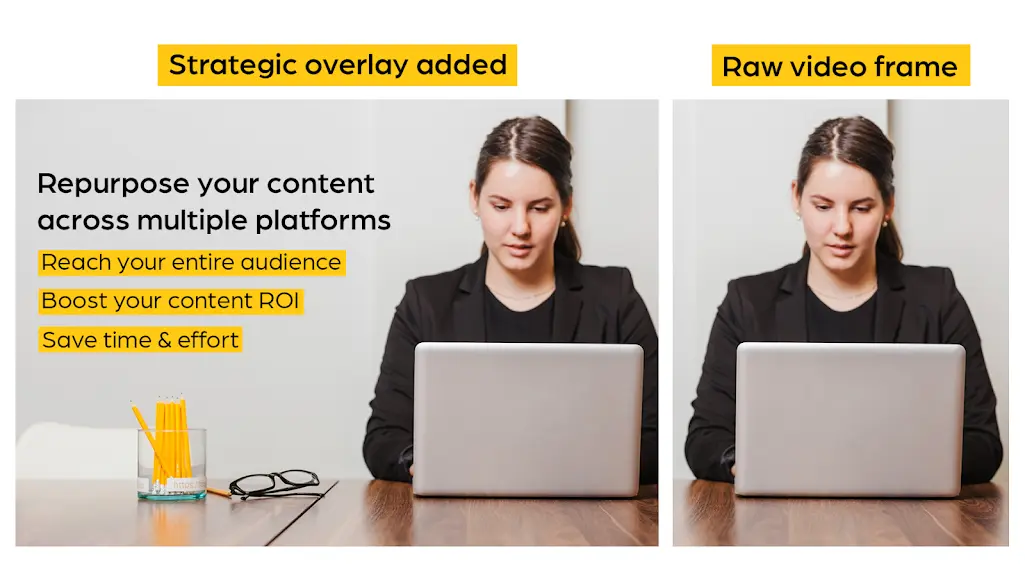
Text overlays are different from captions. They are strategic, designed graphic elements that communicate key messages without requiring the viewer to listen. Used well, they can turn a passive viewer into an active clicker. Used poorly, they clutter the frame and confuse the eye.
- Use benefit-driven overlays early: ‘Save 3 Hours Per Week’ or ‘Join 12,000+ Customers’ placed in the first five seconds add immediate social proof.
- Add a mid-video curiosity bump overlay around the halfway point. Something like ‘Wait for it…’ or ‘Here’s the part most people miss’ has been shown to spike retention.
- For end screens on YouTube, use animated overlays pointing toward the subscribe button or the next video. Static graphics get ignored.
- On Facebook, place a CTA text overlay at the 80% mark of the video, not just at the end. Many viewers leave before the final frame.
- Test contrast ratios for overlay text. White text on light backgrounds is a frequent mistake that makes overlays unreadable.
RULE OF THUMB: EVERY OVERLAY SHOULD EITHER INFORM, REASSURE, OR PROMPT ACTION
Reference Article
Think With Google: Video Ad Sequencing and Creative Best Practices
None of the strategies above means much if you do not test them. Creative testing is the engine that separates a results-driven digital marketing agency in India from one that is just going through the motions. The days of running one version of an ad and hoping for the best are gone. In 2026, the brands winning on Meta and YouTube are the ones running structured, systematic creative tests. And the good news is that you do not need a massive budget to do this right.
Creative Testing for Video Ads: How to Know What Is Actually Working
Most brands test by accident, not by design. They run a few different videos, look at which one got more clicks, and call it done. That is not testing. Real creative testing is a disciplined process of isolating variables, reading platform signals, and making decisions based on patterns, not single data points. Here is how to build a testing system that gives you real answers.
The Variables Worth Testing in Video Ads
The risk with creative testing is testing everything at once and ending up with data that tells you nothing. The key is to test one variable at a time while holding everything else constant. Here are the variables that tend to produce the most significant performance differences:
- Hook variant: Same video body, three different opening five seconds. This is almost always the highest-impact test to run first.
- Aspect ratio: Test 16:9 vs. 4:5 vs. 9:16 for the same content. Different ratios can produce dramatically different thumb-stop rates.
- With captions vs. without captions: The performance gap here consistently surprises brands that have never tested it.
- CTA wording: ‘Shop Now’ vs. ‘Learn More’ vs. ‘Get Yours Today’ can shift click-through rates significantly on the same video.
- Thumbnail or first-frame image: On YouTube, your thumbnail accounts for a large share of whether someone clicks your video at all.
Reading Your Meta and YouTube Creative Data Correctly
Platform dashboards give you numbers, but knowing which numbers actually matter for conversion-focused video is a different skill. A lot of brands optimize for views when they should be optimizing for click-through rate or video-through rate. Knowing the difference matters for where you invest your budget next.
- On Meta, watch your 3-second video plays and your hook rate (3-second plays divided by impressions). Below 25% usually signals a hook problem.
- YouTube’s Audience Retention report will show you exactly where people leave. Dip points reveal structural problems in your video’s pacing.
- Cost per ThruPlay on Meta is more meaningful than CPM for video ads. It tells you the real cost of getting someone to watch most of your message.
- On YouTube, a View-Through Rate (VTR) above 30% is a strong signal for a well-structured pre-roll ad.
- Do not kill an ad based on three days of data. Most platforms need at least seven to fourteen days and 1,000 impressions before results stabilize.
DATA WITHOUT INTERPRETATION IS JUST NUMBERS. BUILD A READING SYSTEM.
Even the most brilliantly crafted video will underperform if it is delivered to the wrong audience or at the wrong moment in their journey. Targeting and sequencing are the distribution layer of video performance, and they are areas where working with the best digital marketing services or a strong marketing services partner in Chandigarh can make a real, measurable difference. The content strategy and the distribution strategy have to work together, not as separate efforts.
Audience Targeting and Video Sequencing: Getting the Right Video to the Right Person
Platforms like Meta and YouTube in 2026 offer audience targeting capabilities that are genuinely sophisticated. The challenge is that most businesses are either over-targeting (too narrow to scale) or under-targeting (too broad to convert). And almost nobody is using video sequencing, which is one of the most powerful and underused tools in the video marketing agency playbook. Here is how to fix both.
Audience Signals That Improve Video Ad Performance in 2026
The goal of targeting is not just to reach people who might buy. It is to reach people who are in the right headspace to receive your video’s message. There is a real difference between those two things, and the platform data you use to build your audiences reflects that difference. Here is what actually works now:
- Use video view custom audiences. People who have watched 50% or more of your previous videos are warm audiences and convert at much higher rates than cold traffic.
- Layer behavioral signals with interest signals on Meta. Behavior-based audiences (like frequent online buyers) outperform interest-only targeting for most e-commerce and SaaS brands.
- For YouTube, use custom intent audiences built around search terms your ideal customers are typing into Google. This is deeply underused.
- Retarget website visitors with a different video than what cold audiences see. Cold audiences need story and education; warm audiences need proof and a push.
- On LinkedIn, job title plus company size plus content engagement is a powerful targeting combination for B2B video campaigns.
Video Sequencing: Building a Journey, Not Just Showing Ads
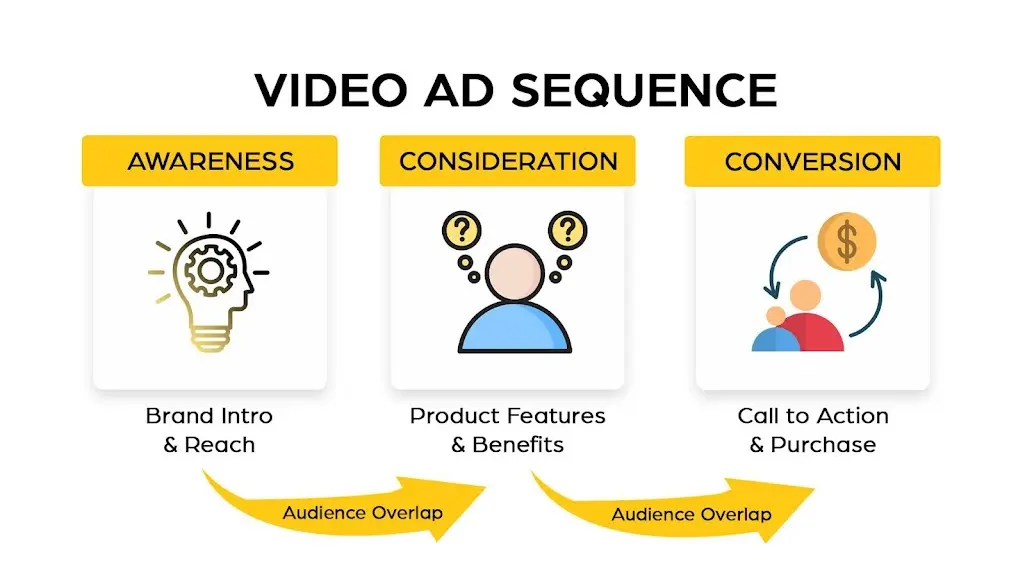
Video sequencing means delivering different videos in a deliberate order to move someone through the buying journey. Facebook calls it video sequence ads, and YouTube has a similar feature. It is one of the most powerful formats available, and almost no small or mid-size businesses are using it. Here is how to think about building a sequence:
- Video 1 (Awareness): A short, story-driven, or emotionally engaging video with no hard CTA. The goal is brand familiarity.
- Video 2 (Consideration): Shown to people who watched Video 1. This video goes deeper, introduces proof, explains differentiators, and starts building trust.
- Video 3 (Conversion): Shown to people who engaged with Video 2. This is your strongest offer video with clear urgency and a direct CTA.
- Video 4 (Retention or Upsell): Shown post-purchase to existing customers. Often, the highest-ROI video is one a brand never thinks to make.
- Keep the visual style consistent across the sequence so viewers recognize the brand across touchpoints.
THE SEQUENCE APPROACH TURNS IMPRESSIONS INTO RELATIONSHIPS
Reference Article
Meta for Business: Video Ad Sequencing Best Practices
The Bottom Line: Your Videos Are Not Broken; They Just Need a Strategy
The shift from generic video to high-converting ad is not about spending more on production. It is about being intentional at every layer: the hook, the structure, the captions, the testing, the targeting, and the sequencing. Brands that figure this out in 2026 will have a meaningful competitive advantage over those that still upload the same corporate video to every platform and wonder why the numbers look flat.
If you are ready to stop guessing and start converting, 42Works is a results-driven digital marketing agency in India with real expertise in video performance marketing across Meta, YouTube, and beyond. Whether you are looking for the best digital marketing services in Chandigarh or scalable digital marketing solutions for a national brand, we can help you build a video strategy that actually performs.
Also Read:
How Custom Mobile App Development Will Grow Your Business in 2026
8 Free Chrome Extensions That Will Power Up Your PPC Campaigns
References
- WordStream: How to Hook Your Audience in the First Seconds of a Video Ad
- HubSpot: Video Marketing Statistics That Will Shape Your Strategy
- Sprout Social: How to Build a Video Content Strategy That Works
- Think With Google: Video Ad Sequencing and Creative Best Practices
- Social Media Examiner: How to Test Facebook Video Ads for Better Results
Tags:
video marketing | video ad strategy | digital marketing agency India | Meta video ads | YouTube advertising 2026
FAQs
1. How do I convert a regular brand video into a Facebook ad that actually gets clicks?
Start with the hook. Re-edit your video so the most compelling moment, a bold claim, a surprising result, or a relatable problem, appears in the first two to three seconds. Then add captions and a clear CTA text overlay near the end. You do not need to reshoot anything. Just recut and reframe.
2. What is the ideal video length for YouTube ads in 2026?
For pre-roll (skippable), aim for 15 to 30 seconds with your core message front-loaded before the five-second skip point. For non-skippable bumper ads, six seconds is the max. For in-stream consideration content, two to five minutes works well if the story holds.
3. Do captions really make a difference to video ad performance?
Yes, and significantly. Meta’s own research has shown captioned video ads increase view time by around 12%, and external studies consistently put engagement lifts from captions even higher for mobile-first placements where sound is off by default.
4. What is a hook rate, and how do I improve mine?
Hook rate is the percentage of people who watch at least three seconds of your video after it appears in their feed. On Meta, you find this in your video metrics. A hook rate below 25% means your opening is not compelling enough. Fix it by leading with conflict, curiosity, or a bold visual.
5. Is it better to use user-generated content (UGC) or produced video for Meta ads?
For cold audience prospecting, UGC-style content consistently outperforms highly produced ads because it looks native and does not trigger the ‘this is an ad’ reflex. For warm audiences and retargeting, polished brand videos with proof and credibility signals tend to perform better.
6. How many video variants should I be testing at once?
Start with three variants of the same video with different hooks. Keep everything else identical. Once you identify the winning hook, then test other variables like CTA wording or format. Testing too many elements simultaneously makes the data unreadable.
7. What does video sequencing mean on Meta and YouTube?
Video sequencing is when you deliver different videos to the same person in a planned order, based on how they responded to the previous one. Someone who watched your awareness video gets your consideration video next. It mimics a real sales conversation and dramatically improves conversion rates compared to showing the same ad repeatedly.
8. How do I repurpose a long-form video without it looking chopped up and cheap?
The key is reframing, not just cutting. When you extract a clip, add a new intro context line or on-screen text that gives the clip a standalone reason to exist. Each repurposed clip should feel like it was made for that format, not like a fragment of something longer.
9. Can a small business with a limited budget still run effective video ads?
Absolutely. A smartphone-shot video with a sharp hook and strong captions will outperform an expensive, poorly structured production every time. Budget matters less than strategy. Start with one strong 30-second video, test three hook variants, and scale the winner with even a modest daily budget.
10. What metrics should I focus on for video ad performance beyond just views?
Focus on hook rate, video-through rate, click-through rate, and cost per thruplay on Meta. On YouTube, watch your ‘View-Through Rate’ and ‘Audience Retention’ curve in YouTube Studio. Views with no downstream clicks or retention mean your video is being seen but not engaged with.
11. How is AI changing video ad creation and optimization in 2026?
AI tools are now being used at every stage: automated caption generation, dynamic creative optimization (where the platform mixes and matches your hooks and CTAs automatically), AI-assisted editing tools like CapCut and Adobe Firefly, and predictive audience modeling. The brands winning are using AI as a speed layer on top of a solid human strategy.
12. What is the difference between a video view campaign and a video conversion campaign on Meta?
A view campaign optimizes for the cheapest views, which often means it finds people who watch videos but never click or buy. A conversion campaign optimizes for people who are likely to take the action you care about. For most businesses with conversion goals, always run conversion-objective campaigns, even for video.
13. What aspect ratio should I use when converting videos for Instagram Reels ads?
9:16 (vertical) is the native format for Reels, and it fills the full screen on mobile. If your original video was shot in 16:9 (landscape), you will need to reframe it. Use the reframe feature in editing tools like CapCut or Adobe Premiere to automatically adjust. Avoid letterboxed content; it looks out of place and tanks retention.
14. How long does it typically take to see results from video ad optimization changes?
Give any new creative change at least seven to fourteen days and a minimum of 1,000 impressions before drawing conclusions. Meta’s delivery algorithm goes through a learning phase with any new ad set, and pulling the plug too early based on day-one data is a common and expensive mistake.
15. How do I get in touch with 42Works to help convert my videos into high-performing ads?
Easy. You can reach the team at 42Works directly by emailing contact@42works.net or calling +91-9517770042. We work with brands across India and globally on video marketing, paid campaigns, and full-stack digital marketing solutions.