

If your website still loads like it’s running on a 2014 shared server, Google noticed long before your users started bouncing. The February 2026 Discover Core Update wasn’t just another quiet algorithm shuffle. And then, before the SEO world even had a chance to breathe, Google followed it up with the March 2026 Core Update, the first broad, global core update of the year, rolling out on March 27, 2026.
Two significant algorithm changes within a single month are unusual, even by Google’s standards. Early data suggests over 55% of monitored sites saw ranking changes within the first two weeks of March alone. So if your traffic has been doing something unexpected lately, you now know why.
Whether you’re a business owner, a developer, or someone relying on digital marketing solutions to grow online, both updates affect you, but in different ways. Let’s walk through exactly what changed, what Google is rewarding, and how to stay ahead of both rollouts.
“Google’s February 2026 Discover Core Update completed its rollout on February 27, 2026, after running for 22 days. It is the first core update in Google’s history scoped exclusively to Google Discover.” Search Engine Land
Two Updates, One Month: What You’re Actually Dealing With
Before we get into fixes, it’s worth separating the two updates cleanly. They’re related, but they work differently and affect different parts of your visibility.
| February 2026 Discover Update | March 2026 Core Update | |
|---|---|---|
| Scope | Google Discover only (US English) | Broad, all regions, all languages |
| Rollout | Feb 5 – Feb 27, 2026 (22 days) | Started Mar 27, 2026 (up to 2 weeks) |
| Main Focus | Content quality, clickbait reduction, page experience in Discover | Broad content quality, E-E-A-T, search intent across all of Search |
| Search Affected? | No (Discover-only) | Yes, affects rankings across all search results |
| Companion Update | None | March 2026 Spam Update (Mar 24–25, finished in <20 hours) |
Source: Google Search Status Dashboard | Search Engine Journal
The February update was a scalpel, precise, Discover-only, and scoped to US English. The March update is a sledgehammer, broad, global, and affecting everything from featured snippets to regular organic rankings. Google described it as a ‘regular update’ designed to better surface relevant, satisfying content. Don’t let the word ‘regular’ fool you. Regular doesn’t mean minor.
What the February 2026 Discover Update Changed
Google specifically targeted Google Discover, the personalized content feed on the Google app and mobile homepage. Three key goals drove this update:
- Showing users more locally relevant content from websites based in their country
- Reducing sensational content and clickbait from Discover feeds
- Surfacing more in-depth, original, and timely content from sites with demonstrated topic expertise
The results were measurable. The number of unique domains appearing in US Discover feeds dropped from 172 to 158, suggesting Google tightened the pool of sites it considers authoritative enough to feature. Sites leaning on sensational headlines or shallow aggregation of trending topics were the most affected.
What Google’s Updated Discover Documentation Warns Against
- Misleading or exaggerated headlines in preview content.
- Hiding the context that users require to understand what a page is about.
- Sensationalist tactics that bait curiosity without delivering substance.
- Auto-playing media and intrusive interstitials that damage page experience.
- Layouts that cause a lot of Cumulative Layout Shifts (CLS) and make the page unstable.
What the March 2026 Core Update Changed
Google officially began rolling out the March 2026 Core Update on March 27 at 2:00 AM PT, with the rollout expected to complete around April 10–11. This is a global update, all regions, and all languages, and it hits regular Search results, not just Discover.
Three things stand out from early analysis of what the March update is rewarding and penalizing:
1. Topical Authority Over Breadth
Google is now evaluating sites at a domain level, not just individual pages. A site that publishes deeply and consistently on one topic outperforms a site that publishes broadly across many unrelated topics. Thin content clusters, even if individually acceptable, can drag down the perceived authority of your entire domain.
2. E-E-A-T Standards Have Tightened Further
Particularly for YMYL (Your Money or Your Life) topics, health, finance, and legal. A study found that 72% of top-ranking pages now display detailed author credentials, up from around 58% before the update. Nameless, authorless content is struggling visibly.
3. Original Research and Proprietary Data Win
Sites with original research, proprietary data, and expert commentary that can’t be found elsewhere saw an average visibility gain of around 22% according to early tracking data. Industry-specific publications and niche blogs with genuine first-hand experience performed particularly well.
Core Web Vitals in 2026: What They Mean (and Why They Still Sting)
Page experience was already a key factor for Discover after February. With the March Core Update now live, Google’s own benchmarks at web.dev remain the baseline for what ‘good’ looks like across both updates.
The Three Metrics You Must Know
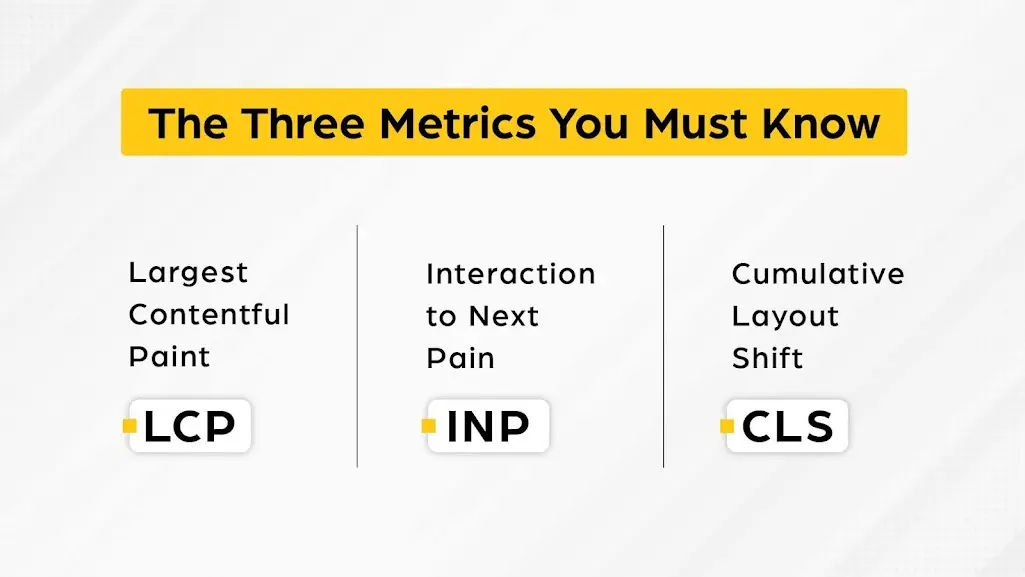
1. Largest Contentful Paint (LCP)
Measures how long it takes for the biggest visible content on your page to load. Slow-loading pages with poor LCP correlated directly with ranking losses in Discover after February, and that signal continues into the March update. Target: under 2.5 seconds.
2. Interaction to Next Paint (INP)
INP replaced FID and measures how fast your page responds to every user interaction. Google formally introduced INP into Core Web Vitals in May 2023, and both 2026 updates have reinforced its importance. Target: under 200 milliseconds.
3. Cumulative Layout Shift (CLS)
Measures how much your page layout unexpectedly moves during loading. Google’s Discover documentation explicitly flags high CLS as a negative signal. Target: under 0.1.
Core Web Vitals Benchmarks at a Glance
| Metric | What It Measures | Good | Needs Improvement | Poor |
|---|---|---|---|---|
| LCP | Page load speed (main content) | ≤ 2.5s | 2.5s – 4s | > 4s |
| INP | Responsiveness to interactions | ≤ 200ms | 200ms – 500ms | > 500ms |
| CLS | Visual stability during load | ≤ 0.1 | 0.1 – 0.25 | > 0.25 |
Source: web.dev/vitals, Google’s official benchmarks
How to Optimize for Page Experience Across Both Updates
Here’s what genuinely moves the needle, especially as a business relying on digital marketing services in Mohali or anywhere in India to compete online.
Fix Your LCP First
- Convert images to WebP or AVIF format (Google now supports AVIF in Google Search).
- Add fetchpriority=”high” to your hero image.
- Use a CDN to serve assets from edge locations closer to your users.
- Defer non-critical JavaScript and eliminate render-blocking resources.
Bring Down Your INP
- Break up long JavaScript tasks into smaller chunks using scheduler.postTask().
- Remove unused JavaScript and third-party scripts that run on every page load.
- Debounce or throttle scroll and resize event listeners.
- Test with the Chrome DevTools Performance panel to find specific bottlenecks.
Stop Your Layout from Jumping
- Always set explicit width and height attributes on images and video embeds.
- Reserve space for ads before they load using min-height on ad containers.
- Avoid injecting content above the fold after the initial page render.
- Use font-display: swap carefully to avoid text flash causing layout shifts.
Make Your Images Discover-Ready
Large images of at least 1200px wide are a confirmed requirement for high-quality Discover card status. You also need to add the max-image-preview:large meta tag in your page head. Without it, your big image simply won’t render in Discover’s large format, no matter how beautiful it is.
Build Topical Authority, Now More Than Ever
This is the March update’s clearest lesson. Rather than publishing across a wide range of loosely related topics, cluster your content tightly around your core subject areas. One deep, well-researched article beats five thin pieces every time. Working with a reliable SEO agency in Chandigarh that understands content strategy alongside technical signals is genuinely the fastest path to topical credibility.
Run a Full Technical SEO Audit
Both the February and March updates reinforce why technical audits matter. A good audit covers Core Web Vitals, mobile usability, crawlability, internal linking, and structured data. If you need help, the best SEO services in Chandigarh will give you a clear, prioritized checklist.
E-E-A-T Is Now Non-Negotiable
Page speed matters a lot. But speed without substance won’t get you far in 2026. Google’s E-E-A-T framework (Experience, Expertise, Authoritativeness, and Trustworthiness) has transitioned from a behind-the-scenes factor to a front-and-center ranking signal. The February 2026 update specifically rewards content that:
- Demonstrates real depth of coverage and supporting evidence.
- Cite authors and their real-world credentials clearly.
- Shows first-hand experience instead of superficial opinions.
- Establishes topical authority across a cluster of related content, not only individual pages.
If you’ve been producing content as a volume play, it’s time to rethink. You can consult some of the best SEO services in Chandigarh, and they’ll guide you and tell you the same thing: fewer, better, more authoritative pieces consistently outperform thin content spam.
Related Read from 42Works
- Will AI Replace SEO? Here’s the Truth You Need to Know
- Best SEO Company in Chandigarh – 42Works
- Best Website Designing Company in Chandigarh and Mohali
What to Avoid After Either Core Update
Reactive changes often create more instability, not less. And with the March rollout still completing around April 10–11, the rankings you see right now are mid-rollout movements, not your settled new reality. Here’s what not to do:
- Don’t go nuking and rebuilding your content strategy overnight because of one traffic drop.
- Don’t make the mistake of over-indexing on technical fixes while ignoring content quality, or vice versa.
- Don’t assume a drop means a penalty. Core updates redistribute rankings; they aren’t punishments.
- Don’t stop publishing. Consistent output signals to Google that you’re an active, reliable source.
Tools You Need in Your 2026 SEO Stack
You can’t improve what you don’t measure. These are the tools that matter right now:
Google Search Console
The Discover Performance report shows impressions, clicks, CTR, and top-performing Discover content.
Google PageSpeed Insights
For CWV analysis and mobile usability diagnostics.
Chrome DevTools / Lighthouse
For in-depth local performance testing and INP profiling.
Screaming Frog SEO Spider
For technical audits: image optimization, meta tags, redirect chains.
SEMrush or Ahrefs
For topic authority analysis and competitive gap research.
Google Analytics 4
For tracking how Discover visitors behave once they land on your site.
The Global Picture: What’s Coming Next
The February 2026 Discover Core Update is still US English only. Google confirmed it will expand to all countries and languages in the coming months. The March 2026 Core Update, by contrast, is already global from day one.
For businesses using digital marketing services in Chandigarh and across India, this is a critical context. Your Search rankings are already being affected by March. Your Discover presence in India is next in line as the February changes roll out globally. The window to act is now.
The best SEO companies in Chandigarh aren’t waiting for the rollout to complete before making improvements. They’re treating both updates as the same signal: Google wants faster, more authoritative, more useful content, and it wants it to be easy to read on a phone. That’s it. That’s the playbook.
Reference Articles
- Google’s February 2026 Discover Core Update, Google Search Central Blog
- Google March 2026 Core Update Rolling Out, Search Engine Land
- Google Begins Rolling Out March 2026 Core Update, Search Engine Journal
- Google March 2026 Core Update Rolling Out, Search Engine Roundtable
- Google’s March 2026 Core Update: What Changed and What to Do, Kahunam
- Google March 2026 Core Update, Google Search Status Dashboard
- Core Web Vitals, web.dev (Google)
Conclusion
Here’s the truth that most people don’t want to hear: there is no shortcut. February tightened Discover. March raised the bar for all of Search. Two updates, one clear message: Google is rewarding sites that are fast, stable, authoritative, and genuinely useful.
If your site is mid-rollout right now and traffic is wobbling, don’t panic; the March update completes around April 10–11, and your numbers won’t settle until then. What you can do is start improving now so that when things stabilize, you’re in a better position than before.
Whether you’re working with the best SEO company in Chandigarh or managing things yourself, the 2026 playbook is clear: fix your Core Web Vitals, build topical authority, put real people behind your content, and keep your page experience clean. Do that consistently, and no algorithm update can take that away.
If you’re looking to turn these updates into an advantage, 42Works helps brands build faster, smarter, and more resilient websites, grounded in real SEO strategy.
FAQs
1. What is the Google February 2026 Discover Core Update?
This is also the first dedicated core algorithm update specifically for Google Discover. The rollout occurred on Feb 5-27, 2026 (22 days), targeting US English users for your content quality, local relevance, and page experience keys before a worldwide release.
2. Does the 2026 update affect regular Google Search results?
The update was officially aimed just at Discover. Numerous SEOs noticed noticeable movement in the wider Search around the same time; however, Google didn’t confirm separate Search changes from this update.
3. What are Core Web Vitals, and why do they matter in 2026?
Core Web Vitals are Google’s performance metrics that include LCP (load speed), INP (interactivity), and CLS (visual stability). They impact Search rankings and Discover appearances.
4. What is a ‘good’ LCP score according to Google?
Google considers LCP of 2.5 seconds or under as ‘good.’ Between 2.5 and 4 seconds needs improvement, and above 4 seconds is flagged as poor.
5. What replaced First Input Delay (FID) in Core Web Vitals?
Interaction to Next Paint (INP) replaced FID. INP measures the responsiveness of every user interaction. Target: under 200 milliseconds.
6. How can I check my website’s Core Web Vitals score?
Use Google PageSpeed Insights (pagespeed.web.dev) for page-level reports and Google Search Console’s Core Web Vitals report for site-wide field data.
7. My site’s Discover traffic dropped after February 2026. What should I do?
Audit your Discover Performance report in Search Console. Then check CWV scores, content depth, E-E-A-T signals, image sizes (min 1200px), and remove clickbait headlines.
8. Does image size actually affect Google Discover visibility?
Yes. Google requires images to be at least 1200px wide with the max-image-preview:large meta tag for large-format Discover cards.
9. What is E-E-A-T, and how does it relate to the 2026 update?
E-E-A-T stands for Experience, Expertise, Authoritativeness, and Trustworthiness. The February 2026 update rewarded topical depth, identified authors, and first-hand experience content.
10. How does this update affect websites outside the US?
The initial rollout only affected US English users. Google confirmed global expansion to all countries and languages in the coming months.
11. What is the difference between a core update and a spam update?
Core updates adjust how Google weighs quality signals generally. Spam updates go after manipulative techniques, such as keyword stuffing and link schemes.
12. Is page speed really a ranking factor or just a tiebreaker?
Both, depending on context. For Discover, page experience acts as a tiebreaker between content with equal topical authority.
13. How often should I run a technical SEO audit?
After every major Google core update and quarterly otherwise. For active sites, monthly crawls help catch broken links, missing alt text, and redirect chains early.
14. Can WordPress sites achieve good Core Web Vitals scores?
Absolutely, but it usually takes work. Use a lightweight theme, a caching plugin, and lazy-load images, and avoid too many page builder assets. WordPress 6.8 also brought useful performance improvements.
15. How can I get in touch with 42Works for SEO and digital marketing help?
Reach out at contact@42works.net or call +91-9517770042. The team will make things clear to you, whether it is a Core Web Vitals audit, content strategy, or full-fledged digital marketing services in Chandigarh.