

Look, if you’re wondering whether Java is still worth your time in 2026, WE get it. With hype around newer programming languages such as Rust, Go, and Kotlin, the question is whether the 30-year-old programming is still in demand. But this is the thing: Java isn’t merely alive; it’s positively flourishing in ways that might shock you.
Whether you’re hoping to build enterprise-grade applications or need a team of developers who can provide reliable solutions, knowing where Java currently stands on the market is not only useful. It’s essential.
Still not convinced? Let’s talk about what Java can do for your specific needs.
| Download Our Complete Custom Mobile App Development Checklist 👇 |
Why Do Fortune 500 Companies Still Rely on Java?
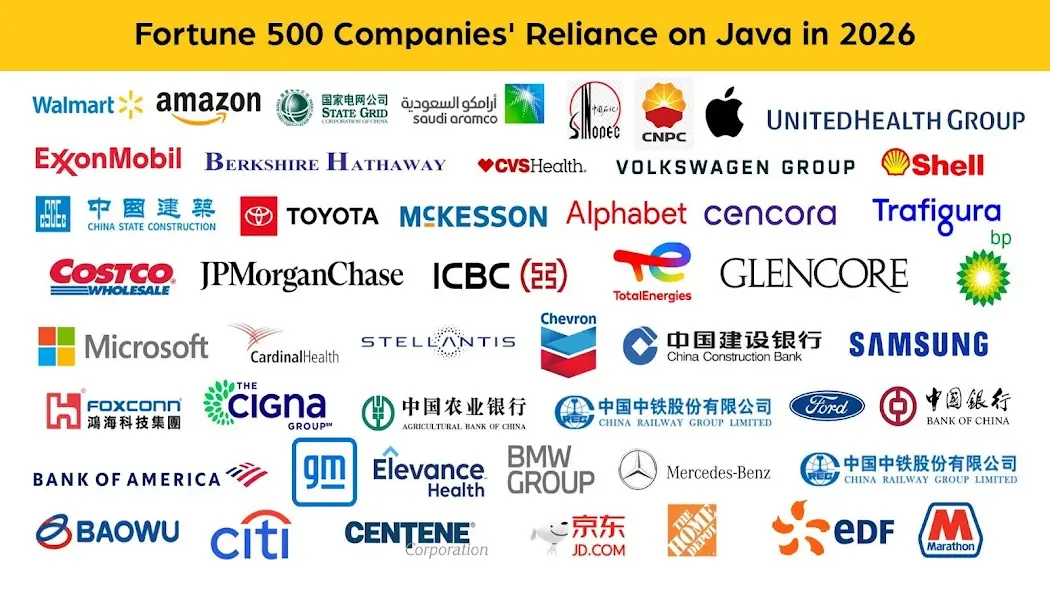
Here’s something that doesn’t get talked about enough: Java isn’t just still in demand in 2026 because of legacy systems. Sure, there are plenty of those. But the real story is that companies keep choosing Java for new projects. Fresh builds. Modern architecture.
IBM, in its report, stated that over 90% of Fortune 500 companies are still running Java in their tech stacks. That’s not because they’re stuck in the past or too lazy to modernize. It’s because the language supports demanding workloads that require stability and predictability.
In large enterprise environments, Java excels at:
- Processing massive transaction volumes reliably.
- Maintaining systems that cannot afford downtime.
- Scaling infrastructure across global environments.
- Supporting strong security and compliance requirements.
The hiring market reflects this demand. Around 39.5% of recruiters are looking for Java developers right now, and there are tens of thousands of job ads on the world’s biggest job board sites.
And these positions are not just about preserving older systems. Most are developing cloud-native platforms, enterprise applications, and modern digital services.
Why Enterprise Giants Keep Coming Back
When you uncover why huge companies keep betting on Java, it comes back to a few things that really do matter in the real world. Let us explain why Java remains relevant in enterprises:
Financial Services

Banks and trading platforms want stability more than anything. Java’s robust error management, stable ecosystem, and long-term stability fit it extremely well for high-risk environments where downtime costs fortunes.
Key advantages include
- Reliable performance in real-time financial systems.
- Integration with legacy infrastructure.
- Proven stability built over decades.
Healthcare

Challenges like privacy and security are paramount when managing medical data. Java benefits from a secure platform with mature tooling, enabling it to meet some of the toughest regulatory requirements without compromise.
As a result, developers can achieve HIPAA compliance in mobile apps and web works by leveraging Java’s secure architecture. Its strong encryption capabilities, along with proven frameworks, ensure the safe handling, storage, and transmission of sensitive patient information.
E-commerce and Global Platforms

Massive e-commerce websites process millions of transactions every day.
Java supports:
- Horizontally scaling with only a slight decrease in performance.
- Managing demand spikes at peak sales points.
- Real-time inventory and payment processing.
Cloud-Native Development

Modern frameworks such as Spring Boot and Quarkus have changed the way Java is working on the cloud.
They offer:
- Faster startup times.
- Container-friendly deployments.
- Kubernetes-ready architectures.
- Improved resource utilization through reactive programming.
Manufacturing and IoT

Java is cross-platform, which means that teams can use the same code on a variety of hardware. This minimizes the programming overhead and makes deployment global across different systems and environments.
The Real Numbers Behind Developer Demand
The job market shows signs of continued strong demand. Estimates predict 18.7 million new Java developer positions by 2026 and US job growth at about 13% by 2028.
Salary trends reinforce this demand:
- Average annual salary of a Java developer in the US: $117,931.
- Senior Java architects: $188,000.
- Full-stack Java developers: roughly $120,804 average.
- Entry-level positions: about $85,000 to $95,000.
And, most of all, Java programmers are not there to keep legacy systems running but to design distributed architectures that afford us the ability to migrate AI and input-output into cloud-based software. It has gotten to be a lot more than just basic CRUD development.
Reference: Softjourn – Is Java Still Used in 2026?
What’s Actually Changed in Java Since 2016?
One mistake people make is thinking Java hasn’t changed much. That’s dead wrong. Java’s release cycle shifted to every six months, which means the language evolves faster than most developers realize. We’re not talking about minor tweaks either.
What’s Actually New and Actually Matters
Java releases have been receiving substantial improvements that are targeting the very real pain points developers have to deal with daily. Let us walk you through what’s actually changed:
i) Virtual Threads simplified concurrent programming
Writing scalable multithreaded applications used to require complex workarounds. Virtual threads changed that, providing a way for developers to deal with concurrency more naturally:
- Write synchronous-style code while achieving asynchronous-level performance.
- Efficiently handle thousands of concurrent connections with much less overhead.
- Reduce complexity when you scale out distributed applications.
- Debug concurrency issues more easily compared to traditional threading models.
This represents a tremendous reduction in development friction for a web app development company that has to build high-traffic platforms or for a mobile app service provider that must run real-time services.
ii) Records reduced boilerplate code
Records introduced a simpler way to define immutable data structures:
- Replace repetitive getter and setter methods with concise declarations.
- Automatically generate equals, hashCode, and toString methods.
- Improve code clarity and maintainability.
- Ideal for DTOs, APIs, and structured data exchange.
Teams working on website development solutions benefit from faster development cycles and cleaner codebases.
iii) Pattern matching modernized syntax
Pattern matching helps improve the readability by putting together type checking and data extraction:
- Replace verbose if-else logic with cleaner switch expressions.
- Minimize casting defects and over-checking.
- Bring Java closer to modern functional programming styles while maintaining familiarity.
This helps to improve maintainability on large projects architected by any experienced website design agency.
Performance and Deployment Improvements
Apart from the syntax changes, Java has concentrated on performance improvements and deployment productivity.
i) Project Valhalla targets memory efficiency
Sponsored by HotSpot Group, Project Valhalla is still very much in development. But nonetheless, it is eagerly awaited, as it has the aim of bringing down a long-standing issue in Java – namely, that it uses more memory than necessary.
- Allow primitives in generics without boxing.
- Improve cache locality and performance.
- Reduce memory footprint for data-heavy applications.
- Particularly relevant for mobile app development solutions and high-performance backend systems.
ii) GraalVM changes startup and runtime performance
GraalVM brings native image compilation, which makes Java applications start much faster:
- Near-instant startup for containerized deployments.
- Faster cold start time for serverless environments.
- Lower memory consumption in production.
- More efficient resource usage that can lower cloud spending.
This opens up new architectural possibilities for organizations providing web app development services or a scalable enterprise platform.
The Framework Evolution That Modernized Java
The change in Java is not the language alone. Platforms like Spring Boot 3 and the next versions have fundamentally changed how we build applications.
Instead of heavyweight setups, modern frameworks now provide:
- Faster startup times, closer to newer languages.
- Native cloud integration across AWS, Google Cloud, and Azure.
- Cleaner APIs that reduce boilerplate.
- Reactive programming models for real-time applications.
- Native compilation options for smaller container images.
Quarkus pushes this even further with a Kubernetes-native design, making it perfect for a website design agency or web app development company focused on microservices architecture.
The Power of Java’s Ecosystem
One of Java’s biggest strong points is the maturity of the ecosystem. Developers rarely start from scratch because:
- There are mature libraries for almost anything.
- Large community support accelerates problem-solving.
- Better maintenance in the long term because of stable tooling.
- Millions of other developers possess shared knowledge to minimize the friction of learning.
For any web development or mobile app development service-providing company creating complex systems, this ecosystem mitigates risk and speeds up time to delivery.
Reference: Java Code Geeks – The Future of Java
What Are Java’s Biggest Limitations in 2026?
Now let’s talk about the parts nobody wants to admit. Java has real limitations, and pretending they don’t exist doesn’t help anyone make informed decisions. Being 30 years old comes with baggage, no matter how many updates you ship.
i) Performance Trade-Offs and Real-Time Constraints
Java comes with an overhead because it’s a high-level language and is executed on the Java Virtual Machine (JVM), in contrast to lower-level languages such as C++ or Rust. In most corporate projects, this is not a significant difference, but in performance-sensitive situations, it does matter.
Situations where Java may struggle include:
- Applications requiring deterministic, sub-millisecond response times.
- High-frequency trading platforms or real-time simulation engines.
- Game engines need direct memory control.
Real-time systems where spikes in latency from garbage collection cannot be tolerated. While recent advances help mitigate some of them, real-time expectations are still hard to meet with typical JVM-based systems.
ii) Memory Consumption and Infrastructure Costs
Java apps have higher memory overhead than Go or Rust. Because the cloud often charges by resource usage at a fixed rate, this higher baseline can cause operational costs to rise.
Key considerations include:
- Larger memory footprint per instance.
- Higher hosting costs over time.
- Challenges for resource-constrained environments.
- Larger container images are impacting deployment efficiency.
For a business that builds web applications or even website development services, for anyone building large distributed systems, these tradeoffs are something you should consider when designing your architecture.
iii) Startup Time and Development Workflow Challenges
Lightweight and faster runtimes tend to start quicker than conventional Java-based applications. Native image compilation and alternate configurations can also be used to ease that, but boot times could negatively impact your development iteration’s speed.
Common impacts include:
- Slower feedback loops during active coding.
- Longer-running unit tests.
- More friction in dealing with microservice architectures.
- Slower iteration compared to Node.js or Python-based workflows.
This can have an impact on productivity for a team providing quick website design or MVP-focused mobile app development services.
iv) Verbosity and Development Speed
The strictness of Java is more conducive to reading and navigating large programs, but can be cumbersome and even overkill for some smaller projects.
Typical challenges include:
- More boilerplate code compared to modern languages.
- Explicit exception handling adds complexity.
- Additional setup for simple programs.
- Slower prototyping compared to dynamic languages.
For an expert web design agency or mobile app developer looking to iterate quickly, all this additional structure can feel limiting.
v) GUI Development and Modern Interface Ecosystems
Java is still big in the backend, but its native GUI toolkits are no match for today’s UI ecosystems. There are better cross-platform user experiences and design tooling via technologies such as Electron, Flutter, or React Native.
As a result:
- Modern design systems integrate more easily with web-based frameworks.
- Developer tooling for Java desktop interfaces can feel dated.
- Frontend-heavy projects often rely on separate technology stacks.
vi) Licensing, Dependency Management, and Complexity
Operational complexity is another item that teams should scrutinize closely. The commercial entity’s licensing has raised question marks for some organizations, despite OpenJDK being freely available.
Additional challenges include:
- Navigating licensing requirements for production environments.
- Managing complex dependencies through Maven or Gradle.
- Version conflicts and transitive dependency issues.
- Increasing build times as projects scale.
These factors can add administrative overhead compared to newer ecosystems.
vii) Concurrency Still Requires Experience
Even with improvements like virtual threads, concurrency remains an area where Java development demands expertise.
Common difficulties include:
- Debugging race conditions.
- Avoiding deadlocks in multi-threaded environments.
- Handling synchronization bugs that appear only under specific workloads.
- Testing concurrent systems effectively.
For teams delivering advanced enterprise-grade web app development solutions, these challenges are manageable but require strong engineering practices.
The Balanced Reality
Such inadequacies of Java do not make it an obsolete or inefficient language. They instead emphasize that all technologies have trade-offs. At times when it’s most important for reliability, scalability, and ecosystem maturity, Java would win. But if the projects are focusing on ultra-low latency, fast experimentation, and lightweight deployment models, they may need another way to do so.
Reference: Dr. Balvinder Taneja – Challenges of Java
The Verdict: Where Java Fits in Your 2026 Tech Stack
So what is it, exactly, that Java does well? These are not contrived examples; these are actually common real-world situations where Java just keeps bringing value:
When Java Is the Right Choice
Let’s be specific about where Java excels. These aren’t theoretical scenarios; they’re real-world use cases where Java consistently delivers value:
i) Enterprise Applications Handling Massive Scale
If you’re creating systems that have to handle millions of transactions, thousands of concurrent users, and maintain uptime measured in nines after the dot, Java is very good at this:
- Battle-tested tooling for monitoring and diagnostics.
- Deployment patterns proven across industries.
- Horizontal scaling capabilities that just work.
- Load balancing and failover mechanisms.
- Decades of optimization for high-throughput scenarios.
ii) Long-Term Maintainability Matters
Code that will be maintained for 10+ years benefits from Java’s stability:
- Language evolves carefully with backward compatibility.
- Codebases from 2015 still compile and run today.
- Corporate environments value predictability.
- Migration paths between versions are well-documented.
- Breaking changes are rare and telegraphed years in advance.
iii) Team Expertise Already Exists
If your organization has skilled Java developers, leveraging that expertise makes sense:
- Retraining entire teams on new languages is expensive.
- Switching languages introduces risk to delivery timelines.
- Experienced developers can be highly productive immediately.
- Institutional knowledge about your systems remains valuable.
- Hiring Java developers remains easier than niche languages.
Also Read This: Is Your Business Facing Challenges? How AI App Development Enables Smarter Solutions in 2026
iv) Integration With Existing Systems
Many organizations have existing Java infrastructure, libraries, and services:
- Building new components in Java simplifies integration.
- Reduces cognitive overhead of context switching.
- Shared libraries and utilities work across projects.
- Consistent deployment pipelines and tooling.
- Easier code reviews when everyone knows the language.
v) Android Development Still Needs Java
While Kotlin is officially preferred, Java remains fully supported and widely used:
- Millions of existing Android apps run on Java.
- Maintaining legacy apps requires Java expertise.
- Gradual migration from Java to Kotlin is common.
- All Android APIs work perfectly with Java.
- Large codebases can’t switch overnight.
When to Look at Alternatives
Be honest about cases where Java isn’t the optimal choice. Picking the wrong tool for the job hurts everyone:
i) Rapid Prototyping and MVPs
Python’s conciseness makes it better for quickly testing ideas:
- A faster feedback loop helps you iterate quickly.
- Less ceremony means faster pivots.
- Dynamic typing speeds up initial development.
- Fewer files and classes to manage.
- Save Java for when you know what you’re building.
ii) Frontend-Heavy Applications
JavaScript and TypeScript dominate the frontend landscape for good reasons:
- Using Java for the backend while the team knows JavaScript makes sense.
- Don’t force Java into frontend work where it doesn’t belong.
- React, Vue, and Angular ecosystems are mature.
- Front-end tooling and frameworks favor JavaScript.
- User interface development is JavaScript’s home turf.
Check This Out: How 42Works designs intuitive and user-friendly mobile apps that deliver seamless innovation, keeping your business connected on the go.
iii) Machine Learning and Data Science
Python’s ecosystem for ML and data science is unmatched:
- TensorFlow, PyTorch, and scikit-learn dominate the field.
- Jupyter notebooks make experimentation easy.
- Community momentum means better libraries and examples.
- Java has ML libraries, but you’ll swim against the current.
- Use the tools that have community support behind them.
iv) Systems Programming Requiring Fine Control
C++ or Rust gives you the low-level control and performance characteristics that systems programming demands:
- Manual memory management when you need it.
- Zero-cost abstractions for performance-critical code.
- Direct hardware access without JVM overhead.
- Predictable performance without garbage collection.
- Java’s abstractions get in the way here.
v) Small Serverless Functions
The cold start problem, even with GraalVM improvements, makes Java less ideal for small, frequently invoked serverless functions:
- Languages designed for fast startup work better here.
- Go and Node.js excel in serverless environments.
- Billing is per millisecond, so startup time costs money.
- Function-as-a-service platforms favor lightweight runtimes.
- Java works better for longer-running containerized services.
Reference: Netguru – Is Java Still Used?
Your Next Steps With Java in 2026
Java is not fading away. It continues to evolve with modern web and mobile app development practices and enterprise needs. Rather than relying on legacy momentum, it is adapting to new architectures, tooling, and industry demands.
i) Modern Evolution and Technical Direction
Java’s current growth is shaped by how well it fits into modern engineering workflows:
Cloud-native development
- Frameworks like Spring Boot and Quarkus support scalable, distributed architectures.
- Designed for containerized environments and microservices.
Reactive and modern programming models
- Better handling of concurrent workloads.
- Improved efficiency for high-traffic applications.
Container optimization
- Reduced memory footprints compared to earlier implementations.
- Improved compatibility with Kubernetes and cloud deployments.
AI and ecosystem integration
- Mature libraries supporting data processing and AI integration.
- A strong tooling ecosystem that accelerates enterprise development.
ii) Market Validation and Industry Demand
The continued investment in Java reflects active industry confidence:
- 90% adoption rate among Fortune 500 companies.
- 18.7 million new Java positions are projected by 2026.
- Average salaries are around $117,931 annually.
- Senior roles reach up to $188,000.
- Job growth is projected at 13% through 2028.
These indicators show that organizations still rely on Java for enterprise platforms, backend systems, and large-scale applications.
iii) Understanding the Trade-Offs
Despite its strengths, Java is not the right choice for every project. Teams should be aware of key constraints:
- Higher memory usage
- Startup performance
- Code verbosity
- Project suitability
iv) Making the Right Decision
Instead of asking whether Java is still relevant, focus on whether it aligns with your project requirements:
- Evaluate technical trade-offs for your specific use case.
- Consider your team’s existing expertise.
- Think about long-term scalability and maintenance.
- Assess regional talent availability.
- Base decisions on evidence rather than trends.
If enterprise-grade reliability, a mature ecosystem, and a large talent pool are priorities, Java remains a strong and dependable choice in 2026.
Conclusion: Is Java Still Worth Choosing in 2026?
Java remains highly relevant in 2026 because it continues to evolve while delivering the stability and scalability enterprises rely on. While it has trade-offs and isn’t ideal for every use case, it remains a strong choice for building reliable, large-scale applications when long-term maintainability matters.
Need help deciding if Java fits your project? 42Works helps businesses choose the right technology stack and build scalable, future-ready solutions. Let’s discuss your requirements.
Also Read:
Is Your Business Facing Challenges? How AI App Development Enables Smarter Solutions in 2026
The 2026 Website Development Trends No One Is Talking About Yet
2026 Will Break Most Java Developers — Unless You Learn These Spring Boot Trends
FAQs
1. Which is the most popular programming language in 2026?
There isn’t a single universal winner because popularity depends on the use case. JavaScript dominates frontend development, and Python leads in AI and data science, while Java remains one of the most widely used languages for enterprise systems, backend platforms, and large-scale applications.
2. Will Java be replaced by AI?
No. AI is changing how developers work, but it doesn’t replace programming languages. Instead, AI tools help developers write, test, and optimize code faster. Java continues to evolve alongside AI by integrating with machine learning tools and enterprise automation workflows.
3. Which language will replace Java?
There isn’t one language positioned to fully replace Java. Some teams may choose alternatives like Go for lightweight services, Kotlin for Android development, or Rust for performance-critical systems, but Java still holds strong where scalability, stability, and long-term maintainability matter.
4. Is Java’s biggest limitation in 2026 technical or cultural?
It’s a mix of both. Technically, Java can have higher memory usage and slower startup times compared to some newer languages. Culturally, some developers perceive it as verbose or traditional. However, modern updates and frameworks have addressed many of these concerns.
5. Is Java falling behind in 2026?
Not really. While newer languages gain attention, Java continues to evolve with features like virtual threads, pattern matching, and performance improvements. Its strength lies in steady innovation rather than rapid hype-driven change.
6. Why do enterprises still choose Java for new projects?
Organizations value Java’s reliability, mature ecosystem, strong security capabilities, and large talent pool. These factors reduce long-term risk when building systems that must run for years without major disruptions.
7. Is Java still a good career choice for developers?
Yes. Demand remains strong across industries such as finance, healthcare, cloud platforms, and e-commerce. Developers who combine Java with modern skills like cloud architecture or microservices are especially in demand.
8. Is Java suitable for cloud-native development?
Modern frameworks like Spring Boot and Quarkus have made Java highly compatible with cloud-native architectures. Containerization, Kubernetes deployments, and reactive programming models are now common in Java environments.
9. Does Java struggle with performance compared to newer languages?
In most enterprise scenarios, performance is more than sufficient. However, for ultra-low latency systems or resource-constrained environments, languages like Rust or C++ may provide more fine-grained control.
10. Is Java too verbose compared to modern languages?
Older Java versions required more boilerplate code, but newer features such as records and pattern matching have significantly reduced verbosity. Modern frameworks also streamline development workflows.
11. Is Java still relevant for Android development?
Yes. Kotlin is officially preferred, but Java remains fully supported and widely used. Many existing Android apps are built with Java, and developers continue maintaining and evolving those codebases.
12. Should startups use Java for MVPs?
It depends on priorities. If speed of experimentation is critical, lightweight languages like Python or Node.js may help teams iterate faster. However, if scalability and long-term architecture are primary concerns, starting with Java can make sense.
13. How does Java compare to Go or Rust in modern development?
Go focuses on simplicity and lightweight services, while Rust excels in performance and memory safety. Java’s strength lies in enterprise-grade scalability, a mature ecosystem, and extensive tooling support.
14. How can 42Works help me decide if Java is right for my project?
42Works helps businesses evaluate technical requirements, long-term scalability, and development goals before choosing a technology stack. The team focuses on practical solutions that balance performance, maintainability, and business outcomes.
15. How can I contact 42Works for consultation or project discussion?
You can reach out directly via email at contact@42works.net or call +91-9517770042 to discuss your project requirements and explore the best technology approach for your business.