
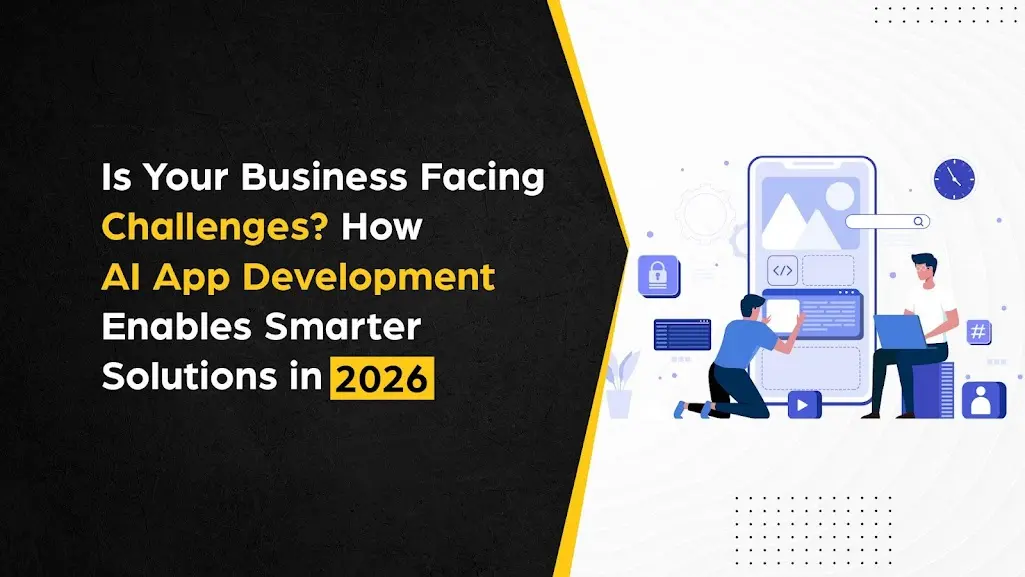
Did you know? By 2026, over 80% of enterprises will be using AI. If clunky systems and manual work are holding you back, you’re not alone. Traditional tools can’t keep up. The answer isn’t just another app. It’s building intelligence directly into your workflow.
Dedicated AI app development services are how forward-thinking businesses are making that shift. If you’re looking locally, success now hinges on finding a mobile app development company in Mohali or a mobile application development service in Chandigarh that makes AI a core part of their solutions, not just an add-on.
Source: Gartner
Let’s explore how to build that intelligence for you. Get in touch with 42Works today!
Download Our Complete Custom Mobile App Development Checklist 👇
42Works’ Custom Mobile App Development Checklist
Why Traditional Apps Fail to Solve Modern Business Problems
Think about the first smartphone you owned. It felt revolutionary at the time, right? But compared to what you hold today, it’s practically a relic. Many business applications are in that same outdated position. They function, but they lack the intelligence to handle today’s complexity.
These conventional apps are built on static logic. If X happens, do Y. They can’t interpret nuance, predict a user’s next move, or personalize an experience in real time. In a world where customer expectations and operational data are constantly flowing, this rigidness becomes a major bottleneck. You need a system that doesn’t just process data but understands it.
The Core Limitation: Absence of Learning
At their heart, companies providing traditional apps follow a fixed script. This results in mobile applications that have less flexibility and adaptability.
What they consistently miss:
- Adaptive Responses: They cannot improve their own performance based on new data. Every upgrade requires manual developer intervention.
- Predictive Capability: They show you what has happened in detailed reports, but they offer little insight into what will happen, leaving you reactive.
- Contextual Awareness: A basic e-commerce app might recommend products based on past purchases. An intelligent one understands seasonality, current trends, and even what similar users are exploring right now.
What Is AI App Development, Really?
Let’s move beyond the buzzword. AI app development is not about building a robot that operates your business. It’s about building layers of cognitive capability into your digital products. Now imagine giving your application eyes to see patterns, a brain to make sense of them, and the intelligence to perform tasks or suggest what choices should be made on its own.
This would require adding capabilities such as machine learning (ML), natural language processing (NLP), or computer vision into the application logic of mobile or web applications. It turns them from instruments into active participants. For businesses, that means selecting a provider offering real AI mobile app development and not some superficial chatbot module.
The Building Blocks of Intelligence
So, what actually goes into building this intelligence? It’s a specialized mix of capabilities.
Key technical components include:
- Machine Learning Models: These are the algorithms that learn from your specific business data. For instance, a model can learn to identify fraudulent transactions unique to your user base, far beyond generic rules.
- Data Pipeline Architecture: AI is fueled by data. A robust backend system to clean, process, and feed data to the models is crucial, something experienced cloud-native developers excel at.
- API Integration for Cognitive Services: Often, the fastest path is leveraging pre-trained AI capabilities (like sentiment analysis or image recognition) from major cloud providers and customizing them for your app’s context.
How AI App Development Solves Key Business Pain Points
This is where the theoretical meets the practical. Let’s connect the dots between AI’s capabilities and the pressing problems you might be facing right now.
Automating the Invisible Time-Sinks
How much of your team’s week is spent on repetitive, manual tasks? Data entry, sorting customer queries, and generating basic reports? According to a survey by Smartsheet, 40% of employees spend at least a quarter of their workweek on manual, repetitive tasks. AI can silently take over these chores, freeing up human talent for strategic, creative work that drives growth.
Practical automations you can implement:
- Intelligent Document Processing
Invoices, forms, and contracts can be read, classified, and key information extracted directly to your systems. This cuts processing time from hours down to seconds and all but eliminates human error. Dynamic Customer Support Triage
A layer of AI can process incoming support tickets, understand the intent and priority of those requests, and then push them to the right agent (or automatically answer common issues on the fly).
Automated Content Moderation
For user-generated content platforms, AI can also scan and flag inappropriate text, images, or videos before they are posted or uploaded so that the community standards are being upheld 24/7.
Seeing the Future: Decision-Making with Real-Time Insights
Gut feeling has its place, but data-driven confidence is unbeatable. AI apps analyze live data streams to provide insights you can act on immediately, not in a monthly board meeting.
Transforming decision-making across functions:
Predictive Inventory Management
In retail, an AI model could take in sales data, weather forecasts, details of local events, and social sentiment to forecast demand for individual products at individual locations, minimizing inventory levels and waste.
Real-Time Risk Assessment
In fintech, AI can assess a loan application by looking at thousands of data points, from transaction history to device behavior, in milliseconds, providing a much more refined risk profile than any fixed checklist.
Dynamic Pricing Engines
Airlines and hospitality have done this for years. Now, AI enables smaller e-commerce businesses to adjust prices dynamically based on competitor activity, inventory levels, and user demand signals.
3 Popular AI App Development Use Cases Across Industries

The beauty of AI is its versatility. Its application is transforming sectors in very specific, tangible ways.
1. AI App Development for Healthcare: Beyond Telemedicine
Healthcare apps are no longer just for virtual doctor visits. AI is now helping with early diagnosis, ongoing monitoring, and preventive care. This shift is making healthcare more proactive and personalized.
- Apps like Ada and SkinVision use AI to check symptoms and analyze skin.
- Chronic care apps such as MySugr and Livongo adapt to patient habits and provide personalized health guidance.
- AI-powered monitoring helps detect issues early and reduce hospital visits.
- Building such solutions demands strong AI mobile app development services expertise.
- Compliance with HIPAA, GDPR, and healthcare data standards remains critical.
2. AI App Development for Fintech: The Guard and the Guide
Fintech apps must be secure and easy to use. AI helps protect user data while also offering smarter financial advice. This balance builds trust and long-term engagement.
- Apps like Revolut and PayPal use AI-driven fraud detection and behavioral analysis.
- Biometric authentication replaces passwords for safer access.
- Platforms such as Cleo and Mint analyze spending to deliver personalized financial insights.
- AI turns fintech apps into financial wellness companions, not just payment tools.
3. AI App Development for eCommerce: The Personal Shop Assistant
Shopping apps are becoming more intuitive and personal. AI helps users find what they want faster while helping brands predict demand. This creates smoother and smarter buying experiences.
- Amazon and Myntra use AI for personalized recommendations and dynamic homepages.
- Pinterest Lens enables visual search by uploading product images.
- AI predicts trends and supports smarter inventory planning.
- Seamless omnichannel experiences often rely on web app development services combined with advanced AI integration.
Navigating the Technical Hurdles in AI App Development
It’s important to be clear-eyed. Taking your applications and infusing them with AI, well, that’s a whole other story! The first step in dealing with them is to admit that they exist.
Common technical challenges include:
- Quality and Quantity of Data: An AI model is only as good as its training data. Sparse, biased, or noisy data is a root cause of low performance. First steps often require a large amount of data cleaning and organizing.
- Integration Complexity: The AI components must work flawlessly with your existing legacy systems, databases, and third-party APIs. This requires careful architectural planning.
- Explaining the Unexplainable: Sometimes, even developers can’t fully trace why a complex ML model made a specific decision. In regulated industries, developing ways to explain AI decisions (“Explainable AI”) is critical.
- Ongoing Maintenance & Model Drift: An AI model isn’t a “set it and forget it” feature. As world data changes, models can become less accurate (“model drift”). They require continuous monitoring, retraining, and updating.
Do’s and Don’ts of AI App Development
Before jumping in, it is important to understand what to do and what to avoid.
Best Practices vs Common Mistakes
| Do’s | Don’ts |
| Define clear business goals before development | Building AI features without a real use case |
| Use quality and relevant data | Ignoring data privacy and compliance |
| Choose an experienced AI mobile app development agency | Treating AI as a one-time setup |
| Plan for scalability from day one | Overcomplicating the solution unnecessarily |
Following these principles ensures your AI investment delivers real value instead of becoming a costly experiment.
Choosing the Right Partner for Your AI Journey
This isn’t a commodity purchase. Selecting a development partner is perhaps your most critical decision. You need more than a coder; you need a strategic thinker with proven technical depth.
Look for Proven, Tangible Industry Expertise
Choosing the right AI partner goes beyond flashy promises. What matters is whether they’ve solved real problems before. Practical experience often shows up in the details.
- Ask for specific case studies, not high-level claims.
- A reliable mobile app development company in Mohali should explain similar challenges they’ve handled.
- They should clearly outline the problem, the AI approach used, and the measurable results achieved.
- Real outcomes matter more than buzzwords.
Security, Privacy, and Compliance Knowledge Is Non-Negotiable
AI applications often deal with highly sensitive data. Any gaps in security or compliance can create serious risks. Your development partner must treat this as a core responsibility, not an afterthought.
- A strong understanding of data protection laws like GDPR is essential.
- Industry-specific compliance, such as HIPAA for healthcare, must be built into the solution.
- Secure practices like encryption, anonymization, and controlled data access should be applied across the AI lifecycle.
- Compliance should be proactive, not reactive
The Mindset for Custom Solutions Aligned with Your Goals
Every business has unique challenges, data structures, and constraints. A one-size-fits-all AI solution rarely delivers meaningful value. The right partner focuses on alignment, not shortcuts.
- Be cautious of teams pushing prepackaged AI solutions too early.
- A good partner starts by understanding your business goals, data, and limitations.
- AI strategies should be custom-built to support your objectives, not driven by trends.
- The best partnerships are collaborative, stable, and focused on long-term value, not just selling technology.
Are you looking for a partner who brings this blend of expertise, security, and collaborative spirit? Let’s start a conversation about your specific challenges.
Summing Up!
In 2026, the business world is asking for more than digital presence; it’s demanding true digital intelligence. AI-enabled apps are the royalty, empowering systems that don’t merely automate but inflect, adjust, and sincerely enhance your team’s capabilities. This change turns a fundamental operation problem into a sustainable competitive advantage. The adventure starts with a simple decision to leave the old world of legacy behind and discover what intelligence can do for you.
Ready to build that smarter future? Let’s begin the conversation with 42Works.
FAQs
1. How is AI app development different from traditional app development?
Traditional apps work on fixed rules and logic. AI-powered apps go a step further; they learn from data, adapt to user behavior, and get smarter over time without constant manual updates.
2. Is AI app development only meant for large enterprises?
Not at all. While enterprises were early adopters, many startups and growing businesses now use AI to automate tasks, improve customer experiences, and make faster, data-backed decisions.
3. How can I tell if my business actually needs an AI-powered app?
If your team spends too much time on repetitive tasks, struggles to act on data, or reacts instead of predicts, AI is usually a strong fit.
4. Do I need a huge amount of data to build an AI application?
You don’t need massive data from day one. What matters more is having clean, relevant data and a clear plan to improve and scale it over time.
5. How long does it usually take to build an AI-powered mobile or web app?
Timelines vary based on complexity. Smaller AI features can be built quickly, while more advanced, end-to-end intelligent systems take longer and evolve continuously.
6. How can I get in touch with 42Works to discuss AI app development?
It’s easy to start a conversation. Just drop an email at contact@42Works.net or call +91-9517770042, and the 42Works team will help you explore the right AI approach for your business.
These Reads are Worth a Read
Regular vs. Dynamic Mobile Apps: How App Design and Functionality Impact Your Revenue
Top 7 App Performance Bottlenecks That Frustrate Users (And How to Solve Them)
2026 AI Business Predictions