
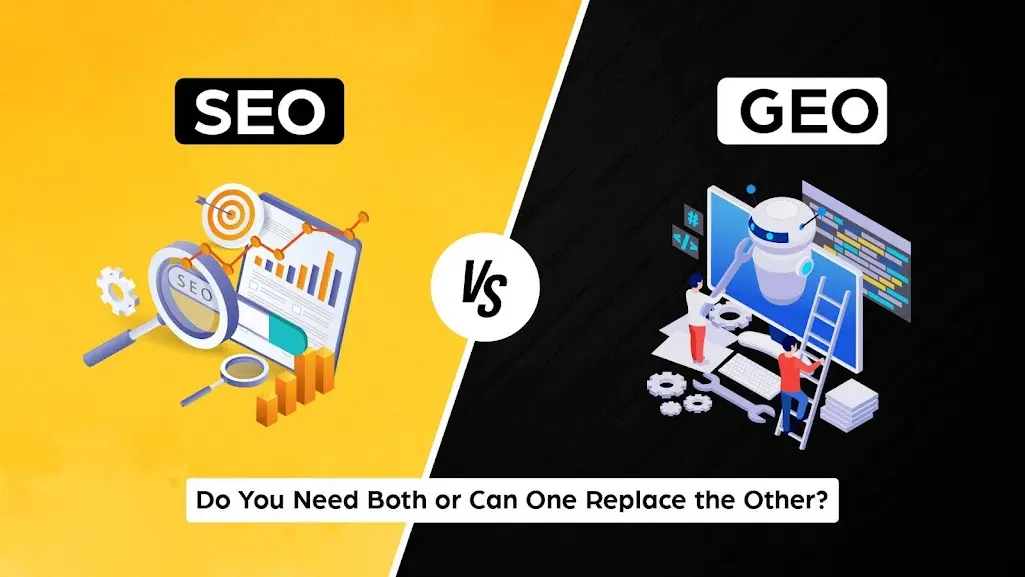
Something shifted in search, and most businesses haven’t caught up with it yet. If you have been watching your organic traffic plateau or dip over the past year, you are not imagining it. And if you have been hearing the term GEO thrown around in strategy meetings without anyone fully knowing it, this blog is for you.
The digital marketing world is going through one of its most significant structural changes in two decades. The debate between SEO and GEO marketing is not just a trend on Twitter. It is a very real question that affects how businesses get found, how brands build credibility, and ultimately how revenue flows. Getting this wrong means becoming invisible to a growing portion of your audience.
So let’s start from where it matters most: why this is suddenly urgent.
The Search Landscape Is Splitting in Two
For nearly twenty years, getting found online meant one thing: rank on Google. Build backlinks, optimize your pages, and target the right keywords. That was the game. And it worked brilliantly. But today, that single pipeline has fractured.
People now discover information through at least two distinct channels. The first are the traditional search engines: Google, Bing, and Yahoo. The second is the AI layer: ChatGPT, Google Gemini, Perplexity, Microsoft Copilot, and tools like Anthropic’s Claude. These are not the same thing. They behave differently, reward different content strategies, and measure success in completely different ways.
80% of people now rely on AI-generated summaries for at least 40% of their searches, according to Bain & Company. That number has grown faster than almost any behavioral shift in the history of digital marketing.
Why Businesses Are Paying Attention Now
The honest reason this feels urgent in 2026 is that consequences have become visible. Brands with strong traditional SEO are watching AI tools give confident recommendations to their competitors instead of them. Companies that relied purely on Google rankings are losing share of voice in AI responses. Neither group had planned for this. That is the gap this blog is designed to close.
Related Read from 42Works
Before diving deeper, this context piece from the 42Works blog is worth a read: Will AI Replace SEO? Here’s the Truth You Need to Know
What is SEO, and What is GEO? Understanding the Core Differences

Before you can decide whether you need one or both, you need honest definitions. The internet is drowning in surface-level explanations that blur the lines. Here is a clear, grounded breakdown of both disciplines.
What is SEO?
Search Engine Optimization (SEO) is the discipline of making your website rank higher on traditional search engines like Google and Bing. When someone types a query, and your page appears in the results, that is the direct output of a well-executed SEO strategy. At its foundation, SEO works by signaling to search engine algorithms that your content is relevant, trustworthy, and technically sound.
The four interconnected pillars of SEO. They feed into each other, and any one pillar left untended weakens the entire edifice:
- On-page SEO: Optimizing content quality and keyword placement, title tags, meta descriptions, header structure, and internal linking. This is the layer most people think of first.
- Technical SEO: Making sure your site is fast, mobile-friendly, crawlable, and free of index errors. Loading speed, visual stability, and interactivity are all core web vitals here.
- Off-page SEO: Developing domain authority via high-quality backlinks, brand mentions, digital PR, and social notifications. The web’s vote of confidence in your content.
- Content strategy: Creating content that matches search intent, answers specific questions thoroughly, and builds topic authority over time.
SEO is not dying. Google still processes over 8.5 billion searches per day. High-intent purchase queries, local business searches, and product comparisons still live overwhelmingly in traditional search. If you are working with an SEO company in Chandigarh or anywhere else in India, the fundamentals of SEO remain completely relevant and necessary.
What SEO Does Well in 2026
It is worth being clear about where SEO still dominates, so you do not underinvest in it while chasing GEO:
- Local intent queries: “Best restaurant near me” and “SEO agency in Chandigarh” are still won in traditional search.
- Product and transactional searches: People buying things still largely use Google. E-commerce visibility depends heavily on traditional SEO.
- High-volume informational content: Articles, guides, and how-to content that rank organically can still result in massive traffic for the brands that keep investing continuously.
- Long-tail keyword traffic: Specific, niche queries that do not yet have a well-formed AI answer default to traditional search results.
What is GEO in Digital Marketing?
Generative Engine Optimization (GEO) is the practice of structuring and positioning your content so that AI-powered tools, such as ChatGPT, Perplexity, Google Gemini, Microsoft Copilot, and others, reference and cite your brand when generating responses. Unlike SEO, which puts you on a list of links that a user must click through, GEO puts your information inside the AI’s actual answer.
Think of it this way: SEO earns you a seat at the table of search results. GEO earns you a speaking role in the AI’s answer. One drives traffic to your site. The other builds your brand’s authority in the AI’s knowledge base.
The term was formally introduced in a 2024 research paper co-authored by researchers at Princeton, Georgia Tech, and IIT Delhi. By 2025, it had entered mainstream marketing vocabulary. By early 2026, enterprise marketing teams across North America, Europe, and major Indian metros will be actively building GEO strategies. Most SMBs, however, are still operating on pure SEO instinct, which means the first-mover advantage right now is real and accessible.
How GEO Differs from Traditional SEO at the Core
There are three fundamental differences between how SEO and GEO work that every marketer needs to understand. These are not surface-level stylistic differences. They affect how you build content, how you measure success, and how you structure your entire digital presence.
- The algorithm is different: Google’s algorithm ranks pages. Generative AI engines synthesize answers from what they deem credible and well-structured sources. There is no ranked list in an AI answer; there is one response, and either you are in it or you are not.
- Traffic behaves differently: SEO success means a user clicks your link. GEO success often means zero clicks; the user gets their answer from the AI, which absorbed your content. Brand impression without a website visit. This is the zero-click reality.
- Authority signals differ: SEO rewards backlinks heavily. GEO rewards citation patterns, named author credibility, multi-platform brand presence, and the structural quality of your content.
GEO vs SEO: Side-by-Side Comparison
This table consolidates the key differences between SEO vs. GEO across the factors that matter most for strategy decisions. Use this as a quick reference when planning your digital marketing investment for 2026.
Factor |
Traditional SEO |
GEO |
Why Both Matter |
|---|---|---|---|
| Primary Goal | Rank on Google/Bing SERPs | Get cited inside AI answers | Cover all discovery surfaces |
| Platforms | Google, Bing, Yahoo | ChatGPT, Gemini, Perplexity, Claude | Users now hop between both |
| Success Metric | Rankings, CTR, Traffic | AI citations, brand mentions, share of voice | Different KPIs, same growth goal |
| Content Format | Keyword-optimized pages | Structured, fact-rich, cited, author-attributed | Overlapping needs, combine both |
| Backlinks | Critical ranking factor | Moderate; E-E-A-T and citations matter more | Backlinks support both signals |
| Traffic Type | Direct website visits | Brand impressions, zero-click awareness | Diversified traffic = resilience |
| Speed of Results | Months to years typically | Faster for niche authority topics | Both reward long-term consistency |
| Technical Setup | Core Web Vitals, crawlability | Schema, structured data, named authors | Nearly identical technical base |
| Who Wins | High-domain-authority sites | Cited, authoritative, multi-platform brands | Authority wins on every surface |
| 2026 Trend | AI Overviews reducing clicks | AI citation volume rising sharply | Ignore GEO = lose AI visibility |
Sources: Search Engine Land | WordStream | Destination CRM
What is AEO, and How Does It Relate to GEO?
Answer Engine Optimization (AEO) was originally developed for voice search, optimizing content so smart speakers and voice assistants would read it aloud. In 2025 and 2026, AEO has largely merged into GEO because voice interfaces are now powered by the same generative AI models. If you are executing GEO correctly, you are covering AEO territory by default. The two terms are often used interchangeably in current marketing literature.
Who Is Affected by This Shift? (More Businesses Than You Think)
The SEO vs. GEO conversation is not only relevant to large enterprises or tech companies with dedicated marketing departments. The shift in how people find information cuts across industries and business sizes. Understanding who is most exposed to this change and who stands to gain the most from acting early is the starting point for any honest strategy.
The Businesses Most Vulnerable to Ignoring GEO
Some business categories are being hit harder than others by the rise of AI-mediated search. Here is what the data and current trends tell us about the most affected groups:
-
E-Commerce and Retail Brands
E-commerce journeys are increasingly starting on AI platforms like ChatGPT and Perplexity, where users get curated recommendations before visiting Google or brand websites. If your brand isn’t part of that first response, you lose early mindshare.
Here’s how this shift is playing out:
- Users begin product discovery on AI tools
- AI shapes initial brand consideration
- Absence means lost visibility early on
- Integrated strategies strengthen acquisition funnels
-
B2B Service Providers and Agencies
B2B decision-makers are relying on AI to research vendors, compare solutions, and generate shortlists. Not appearing in these AI-driven recommendations means missing out on a critical stage.
Key changes in buyer behavior include:
- AI-led vendor discovery and evaluation
- Shortlists increasingly AI-generated
- Visibility influences early decision-making
- Absence reduces credibility in the funnel
-
Local and Regional Businesses
AI tools are now delivering location-based recommendations, highlighting specific businesses for local queries. Only those with strong local authority and optimized content are being surfaced.
This is what it means for local visibility:
- Location-based queries trigger AI suggestions
- Strong local authority improves chances of mention
- GEO-ready content boosts discoverability
- Weak presence leads to no visibility
-
Content Publishers and Media Brands
Being cited in AI responses is becoming as valuable as top search rankings. Content must now aim to be a trusted source for AI-generated answers.
The shift in content strategy looks like:
- AI citations act as authority signals
- Content must be reference-worthy
- Focus moves from ranking to being sourced
- GEO becomes a primary growth lever
Who is Already Winning at GEO
It is worth understanding what the brands appearing regularly in AI responses have in common. Looking at citation patterns across ChatGPT, Perplexity, and Gemini, certain patterns are consistent:
- Strong domain authority: Sites that have invested consistently in SEO over the years have a natural advantage in GEO because AI engines still value domain-level trust.
- Named, credentialed authors: Content by real people with verifiable external profiles (LinkedIn, bylines in publications) and academic credentials is heavily favored.
- Structured, skimmable format: AI parses and summarizes content with a clear hierarchy of headings and subheadings, bullet points, defined sections, or FAQ formats, which is much easier than limiting itself to “pages” that lack formatting.
- Convex (multi-platform brand presence): The brands that appear cared about across Reddit, Quora, corporate blogs, and news sites/forums also appear within the responses more often than brands with a presence only on their own individual domain.
- Original data and cited research: Content that references real statistics from reputable sources, or better yet, publishes its own original research, earns a disproportionate share of AI citations.
Related Read from 42Works
42Works also covered the fundamentals of paid digital strategy in this post: Everything You Need To Know About The Fundamentals of PPC
Where Does This Apply? Industry and Geography Context
Understanding where the GEO opportunity is most meaningful helps prioritize investment. Not all industries are equally disrupted by AI-mediated search, and not all geographies are at the same stage of this shift. Here is an honest regional and industry-level look at where this matters most.
The Indian Digital Landscape in 2026
India is the world’s largest internet user base by volume. With over 900 million internet users and smartphone penetration accelerating into Tier 2 and Tier 3 cities, the search behavior of Indian users is evolving fast. ChatGPT adoption among professionals in metros like Delhi, Bengaluru, Hyderabad, and Chandigarh has grown significantly since 2024. Platforms like Perplexity are gaining ground with students and researchers. And Google’s own AI Overviews, which now appear for a large percentage of English-language queries, are changing what organic search actually looks like.
For businesses in Punjab and Haryana specifically, including those seeking the best SEO company in Chandigarh, the window for differentiation through GEO is still open. Most local competitors are running traditional SEO campaigns and nothing more. That gap is an opportunity.
Industries Where GEO Impact is Most Significant
Some sectors are being disrupted by AI-mediated search faster and more dramatically than others. Here is where the impact is most quantifiable as of early 2026:
- Healthcare and wellness: People commonly use AI tools to ask about symptoms, treatment possibilities, and clinic suggestions. Authoritative, structured, author-attributed medical content continues to be cited routinely.
- Finance and fintech: Investment advice, loan comparisons, and tax guidance are all high-intent queries where AI tools are becoming the first information sources.
- Legal services: “What are my tenant rights?” “How do I file for a trademark?” AI answers these regularly and cites specific legal resources or firms.
- Technology and SaaS: Software comparisons, “best tool for X” queries, and how-to technical content are heavily AI-mediated.
- Education: Career guidance, course comparisons, skill-building content, students are heavy AI users, and educational brands need GEO visibility urgently.
- Digital marketing itself: Businesses searching for the best SEO agency in Chandigarh or digital strategy partners are increasingly using AI as part of their research process.
Where GEO and Local SEO Intersect
One area where the two disciplines converge particularly clearly is local search. Google’s AI Overviews and Gemini are increasingly providing geo-targeted AI responses, meaning the AI gives location-specific answers based on the user’s location and query. A query like “best digital marketing services in Chandigarh” now triggers both traditional local search results AND an AI-generated summary. If your business is optimized for local SEO but not for GEO, you appear in the links below the AI box but not inside the AI’s recommendation itself. That distinction is increasingly costing businesses clicks and calls.
Related Read from 42Works
See how 42Works approaches regional digital strategy: Best Website Designing Company in Chandigarh and Mohali
When Did All This Change? A Timeline That Explains the Urgency
GEO did not appear overnight. It has been building since at least 2022, when large language models began demonstrating the ability to synthesize web content into coherent answers. Understanding the timeline helps you calibrate how urgent this actually is and whether you have already missed the early-mover window (you have not, but the window is narrowing).
The Key Milestones That Got Us Here
Here is the condensed version of how we got from “just do SEO” to “you need GEO too”:
- In November 2022, ChatGPT launches: OpenAI releases ChatGPT to the public. Within two months, it reached 100 million users. Marketers begin noticing that users are using it for research instead of Google in certain categories.
- 2023, Google AI Overviews beta: Google rolls out SGE (Search Generative Experience) in beta. AI-generated summaries begin appearing above organic results for select queries.
- In 2024, GEO was formalized academically: The Princeton / Georgia Tech / IIT Delhi paper formally defines Generative Engine Optimization and demonstrates measurable techniques for improving AI citation rates.
- Mid-2024, Perplexity growth accelerates: Perplexity crosses 10 million daily active users and becomes a legitimate search alternative for research-heavy queries.
- 2025, Enterprise GEO adoption begins: Large brands and enterprise marketing teams start running dedicated GEO audits and restructuring content libraries for AI retrieval.
- 2026, AI Mode goes mainstream: Google’s AI Mode rolls out more broadly. Traditional organic listings are pushed further down the page for a growing category of queries. AI-first search behavior is now measurably mainstream.
Is GEO Replacing SEO? The Honest Answer
This is the question everyone is really asking under the umbrella of GEO replacing SEO. The direct answer is: it’s not replacing, but significantly restructuring.
Gartner forecasts that traditional organic search traffic could decline by 25% by 2026, and by as much as 50% by 2028, primarily due to AI-driven search behavior. Source: ePublishing via Gartner
But here is the critical context: Google is still enormous. WordStream’s 2026 data shows that Google search is approximately 373 times larger than ChatGPT search today. The traffic volume on traditional search is not going to zero. What is changing is its share of the early-stage discovery journey, and that matters enormously for brand building.
Meanwhile, Onimod Global research projects that 15 million US adults used generative AI as their primary search tool in 2024, growing to 36 million by 2028. India’s trajectory is expected to follow a similar curve, accelerated by smartphone adoption and the multilingual capabilities of newer AI models.
When Should You Start on GEO?
The accurate answer is that the best time was 2024, and the second-best time is right now. Here is why timing matters:
- Authority signals take time: Building the external citations, author credibility, and structured content library that GEO needs is not a one-week project. The earlier you start, the faster the compounding begins.
- AI training cycles matter: Generative AI models are retrained periodically. Content that builds GEO signals before major training updates has a head start in the model’s knowledge base.
- Competitors are waking up: In most Indian markets, the GEO window is still open but actively closing. Larger competitors with dedicated digital teams are moving on this now.
How GEO and SEO Work Together: A Practical Strategy Framework
This is the section where theory becomes practice. The goal here is not to give you a generic checklist; you can find those everywhere. The goal is to show you how SEO vs. GEO marketing strategies integrate into a single coherent system that works in 2026 and beyond. Think of this as your unified visibility framework.
Step 1: Conduct a Dual Audit, SEO Health Plus GEO Readiness
Most audits today check technical SEO, on-page optimization, and backlink profiles. That covers only half the picture. A full dual audit in 2026 needs to assess both dimensions. Here is what each side should cover:
SEO Audit Checklist
These are the foundational elements that need to be verified before you can build an effective GEO strategy on top:
- Core Web Vitals: LCP (Largest Contentful Paint) under 2.5 seconds, CLS (Cumulative Layout Shift) under 0.1, and INP (Interaction to Next Paint) under 200 ms.
- Crawlability: No critical pages are blocked in robots.txt, clean XML sitemaps, correct canonical tags, and no redirect chains.
- Keyword mapping: Each primary keyword is mapped to a single page with clear search intent alignment. No cannibalization.
- Internal linking: Topic clusters are connected properly. Pillar pages are linked to supporting content and vice versa.
- Backlink quality: Toxic links disavowed, high-authority relevant links actively built.
GEO Readiness Audit Checklist
These elements specifically determine how likely your content is to be cited or referenced by AI tools:
- Author attribution: Every piece of content has a named author with a bio, credentials, and ideally a verifiable external presence.
- Schema markup: FAQ schema, HowTo schema, Article schema, and Breadcrumb List schemas are implemented correctly across relevant pages.
- Content structure quality: Pages use clear H2-H5 hierarchies, short paragraphs, defined sections, and answer-first formatting.
- Citation density: Content references external credible sources. Stats and claims are linked to their origins.
- Multi-platform presence: Brand mentioned on Reddit, Quora, LinkedIn, industry blogs, and news publications. Not just your own domain.
- Q&A sections: At least one FAQ or Q&A-format section per major content piece.
Step 2: Build a Content Architecture That Serves Both
The most efficient approach to SEO and GEO is not to run two separate content strategies. It is to build a content architecture that satisfies both simultaneously. The good news is that the content types that perform best in GEO, structured, authoritative, well-cited, and deeply researched, are also exactly the content types that traditional SEO rewards in 2026.
The Topic Cluster Model for Dual Optimization
Topic clusters are the content architecture framework that serves both SEO and GEO most effectively. Here is how they work and why they matter for both:
- Pillar page: A comprehensive, authoritative guide to a broad topic. For example, “The Complete Guide to Digital Marketing for Businesses in Chandigarh.” This page targets broad keywords and builds topical authority.
- Cluster content: A set of supporting pages that go deep on specific subtopics, local SEO tactics, content marketing, PPC for small businesses, etc. Each links back to the pillar page.
- Internal linking: Every cluster page links to the pillar and to related cluster pages. This builds a semantic web that search engines use for ranking and that AI engines use for understanding topic depth.
AI engines, when answering a question in your domain, tend to cite sites that demonstrate consistent depth across a topic. A brand that has a pillar page and ten cluster pages on digital marketing solutions will be cited far more frequently than a brand that has one good blog post on the same subject. Breadth of coverage signals expertise in generative AI logic.
Content Formats That Win in 2026
Not all content formats are created equal when it comes to GEO visibility. Based on citation pattern analysis across major AI platforms, the following formats consistently outperform:
- FAQ-format content: Questions and answers structured with clear Q headers and direct, concise answers. AI tools parse these exceptionally well.
- Step-by-step how-to guides: Process-oriented content with numbered steps, clear outcomes, and structured subheadings.
- Original research and data: Surveys, case studies, first-party data, and original analysis. AI engines prefer primary sources.
- Expert interviews and quotes: Named, credentialed experts quoted with specific insights. These act as authority signals for both SEO and GEO.
- Comparison content: “X vs Y” articles with clear, structured breakdowns. High GEO citation frequency for product and service comparison queries.
Step 3: Build Author Authority and E-E-A-T Infrastructure
This is the element most businesses skip, and it is the one that makes the biggest difference for GEO in digital marketing. Google’s E-E-A-T framework, Experience, Expertise, Authoritativeness, and Trustworthiness, was designed for traditional search quality evaluation. But it has become equally central to how AI systems evaluate content credibility for citation.
What E-E-A-T Looks Like in Practice
Building genuine E-E-A-T for GEO means more than adding an author bio. Here is the full picture:
- Named authors: Every piece of significant content needs an attributed author. Anonymous content is increasingly filtered out by generative AI.
- Author pages: Dedicated author pages on your website with credentials, photo, links to external profiles, and a portfolio of published work.
- External validation: Author appears on LinkedIn with a consistent professional profile. Ideally, it has bylines on industry publications beyond just your own site.
- Business credentials: About pages, case studies, client testimonials, awards, and certifications all of these build E-E-A-T signals at the brand level.
- HTTPS and privacy compliance: Basic trust signals that remain important for both SEO and GEO credibility scoring.
Step 4: Optimize Technically for AI Crawlers
AI systems crawl and index the web differently from traditional search engine bots. Here is what that means practically for your technical setup:
Schema Markup Priority for GEO
Schema markup tells both search engines and AI crawlers what your content is, who wrote it, and what it is about. For GEO, these schema types are especially high value:
- FAQ Schema: Wraps Q&A-format content in structured markup. AI tools use this to extract direct answers.
- Article Schema: Includes author, publish date, modified date, and publisher information. Critical for AI to assess content freshness and authority.
- HowTo Schema: Structures a step-by-step process for content. Well-parsed by generative AI for instructional queries.
- BreadcrumbList Schema: Helps AI understand where a page sits within your content hierarchy.
- Organization Schema: Brand name, logo, contact details, social profiles. Builds brand entity recognition in AI knowledge graphs.
Structured Data and LLM Accessibility
Newer developments in 2025 and 2026 include the llms.txt standard, a plain-text file placed in your website’s root directory that provides AI crawlers with a curated summary of your site’s content, structure, and key information. Think of it as a robots.txt, but specifically for large language models. Implementing an llms.txt file, while still relatively early-stage, is a forward-looking GEO signal that a growing number of technical SEOs are recommending. If you are working with an SEO company in Chandigarh or any digital agency, it is worth asking whether they are familiar with this standard.
Step 5: Build Multi-Platform Brand Presence
Your website is one signal. Generative AI engines weigh multi-source mentions heavily because diverse citations suggest broader consensus and legitimacy. Building your brand presence across multiple authoritative platforms is one of the highest-leverage GEO activities you can invest in.
The Platforms That Matter Most for GEO in India
Each of the following platforms contributes to the signal pool that AI tools draw from. Prioritize by relevance to your industry and audience:
- LinkedIn: Particularly important for B2B and professional services. Company pages and author profiles both contribute.
- Reddit and Quora: Discussion forum mentions are actively indexed by AI tools. Helpful, non-promotional answers to relevant questions build GEO visibility.
- YouTube: Video content with well-structured descriptions, transcripts, and clear topic alignment contributes to GEO authority.
- Industry publications and news sites: Guest posts, expert quotes, and press coverage on recognized domain-authority publications carry significant weight.
- Wikipedia mentions: A Wikipedia page or a mention within relevant Wikipedia articles is a strong GEO signal, though difficult to achieve organically.
- Google Business Profile: For local businesses, an optimized GBP with consistent NAP (Name, Address, Phone) data, reviews, and regular updates supports both local SEO and local AI recommendations.
From 42Works: Building Your Online Presence Right
For context on how 42Works approaches full-stack digital presence: Best SEO Company in Chandigarh – 42Works
Upcoming GEO and SEO Trends Worth Watching in 2026 and Beyond
The space is moving fast enough that strategies built in 2024 already need updating. Here are the developments most likely to shape SEO vs. GEO marketing over the next 12 to 24 months.
Trend 1: AI Search Performance Tracking Becomes Standard
By mid-2026, tracking your AI search visibility is expected to be as routine as tracking Google rankings. Tools like Semrush Enterprise AIO, Otterly.ai, and Ahrefs Brand Radar now measure AI citation frequency across ChatGPT, Perplexity, and Google AI Mode. Brands that invest early in AI visibility analytics will have a significant data advantage over those that are still only measuring traditional SEO KPIs.
Trend 2: Topic Authority Displaces Keyword Density
Traditional SEO services in Chandigarh and elsewhere have long focused on keyword density and individual page optimization. GEO, and increasingly, even traditional SEO under Google’s Helpful Content updates, rewards topical authority. This means a brand that has fifty interconnected, high-quality pieces of content on a specific subject will outperform a brand that has one perfectly optimized keyword page on the same subject. Content investment needs to shift from isolated pages to comprehensive knowledge hubs.
Trend 3: Zero-Click is the New Normal, Not the Exception
Zero-click searches, where the user gets their answer without clicking any result, already account for over 50% of Google searches, according to SparkToro analysis. With AI tools further intercepting queries and delivering complete answers, the zero-click phenomenon is accelerating. This fundamentally changes how you think about digital marketing solutions: success metrics need to include brand impression share and AI citation volume alongside traditional traffic metrics.
Trend 4: Multimodal AI Search Adds a New Layer
Newer versions of AI tools like GPT-4o and Gemini 1.5 Pro can process images, audio, and video in addition to text. This means GEO is beginning to expand beyond text content optimization. Product images with proper alt attributes and contextual captions, video transcripts that are searchable and structured, and podcast content with text summaries are all becoming relevant GEO signals. Brands building multimodal content libraries now are positioning well for this next wave.
Trend 5: Personalised AI Responses and Brand Entity Recognition
Generative AI is moving toward increasingly personalized responses. Systems are building user-level models that influence what content they surface. This makes brand entity recognition, the degree to which AI tools confidently associate your brand name with a specific category, value proposition, or expertise, increasingly valuable. Consistently structured, clearly branded content across all your digital touchpoints strengthens this entity signal over time.
Key Stats: The Numbers Behind the GEO and SEO Shift
Numbers help cut through the noise. Here are the verified data points most relevant to how SEO and GEO are evolving in 2026:
- 8.5 billion searches per day are processed by Google, confirming that traditional search is far from obsolete.
- 373x, Google search is still 373 times larger than ChatGPT Search by volume.
- Eighty percent of people rely on AI summaries for at least 40% of their searches.
- 35% of Gen Z now use AI tools as their first research stop vs. 7% for Gen X.
- 25% decline in organic traffic by 2026 and 50% by 2028, forecast by Gartner due to AI-driven search.
- 55% improvement in AI chatbot citation rates for Q&A-format content in early GEO tests.
- 36 million US adults projected to use generative AI as their primary search tool by 2028 (up from 15 million in 2024).
- 50%+ of all Google searches are already zero-click.
Conclusion: It Was Never GEO vs SEO; It Was Always GEO and SEO
Here is the honest takeaway after walking through all of this. The SEO vs GEO framing is a bit misleading. It sets up a false binary. SEO is your foundation; without it, your domain has no authority for AI systems to reference. GEO is your evolution; without it, you are invisible on the AI layer of the internet that is growing fastest.
The businesses that will own their niches by 2028 are not the ones that abandoned SEO for GEO. They are the ones who integrated both into a single, unified content and authority strategy. They invest in structured, authoritative content. They attribute that content to credible named experts. They build a multi-platform presence. They track both traditional rankings and AI citation share.
If you are based in North India and looking for the best SEO company in Chandigarh that already understands this integrated model, not just keyword rankings, not just traffic reports, but real multi-surface visibility that compounds over time, then 42Works is built for exactly this moment.
The team at 42Works has been working with businesses across the Tricity and beyond on digital marketing solutions that span technical SEO, content strategy, GEO readiness audits, and AI visibility building. Because the goal was never a number on a ranking report. The goal was always growth.
Ready to build a strategy that covers both SEO and GEO? Reach out to 42Works today.
FAQs
1. What is GEO in digital marketing?
Generative Engine Optimization (GEO) is the practice of optimizing your content so that AI-powered tools like ChatGPT, Perplexity, Google Gemini, and Microsoft Copilot cite and reference your brand when generating answers. Unlike SEO, which earns you a link in search results, GEO earns you a mention inside the AI’s actual response.
2. What is SEO, and why does it still matter in 2026?
Search Engine Optimization (SEO) is the practice of ranking your website on traditional search engines like Google and Bing. It still absolutely matters in 2026; Google processes over 8.5 billion searches per day and remains the dominant discovery channel for high-intent, purchase-ready queries. SEO is also the foundation that GEO builds on.
3. Is GEO replacing SEO?
No. The two serve different but complementary functions. GEO is not replacing SEO; it is evolving alongside it. Traditional search remains enormous. What is changing is that AI tools are intercepting a growing share of the early-stage discovery journey, which means you need visibility on both surfaces.
4. What is the difference between SEO and GEO marketing?
SEO vs. GEO marketing comes down to what you are optimizing for. SEO optimizes for search engine rankings and positions on a results page. GEO optimizes for AI citations and includes them in generated answers. SEO drives website traffic directly. GEO drives brand authority and zero-click impressions. Both matter. Neither can fully replace the other right now.
5. How does GEO work technically?
Generative AI engines crawl publicly accessible web content and index it based on content quality, structure, author authority, citation patterns, and E-E-A-T signals. When a user asks a question, the AI synthesizes an answer from the most credible, relevant sources in its index. GEO is about making your content recognizably authoritative enough to be included in that synthesis.
6. What type of content works best for GEO?
FAQ-format content, step-by-step how-to guides, original research with sourced statistics, expert interviews, and clearly structured comparison content all perform well for GEO. Content with named, credentialed authors, proper schema markup, and multisource external citations consistently outperforms anonymous or thinly structured content in AI retrieval.
7. What is the difference between GEO and AEO?
Answer Engine Optimization (AEO) was originally developed for voice search. In 2025 and 2026, it has largely been absorbed into GEO because voice interfaces now run on the same generative AI systems. If you are executing a solid GEO strategy, you are covering AEO simultaneously. The terms are often used interchangeably in current industry literature.
8. How do I measure GEO success?
GEO success is measured through AI citation frequency, brand mention share in AI responses, sentiment quality of those mentions, and share of voice in generative AI answers for target topics. Tools like Semrush Enterprise AIO, Otterly.ai, and Ahrefs Brand Radar are specifically built for this type of tracking.
9. Can small businesses in Chandigarh benefit from GEO?
Absolutely, and the opportunity is particularly strong right now. Most small businesses in the Chandigarh Tricity area are still operating on traditional SEO alone. By building GEO-ready content alongside local SEO, regional businesses can appear in AI-generated local recommendations ahead of larger, slower-moving competitors. The window for this first-mover advantage is open but narrowing.
10. Does social media activity help with GEO?
Growing but moderate impact as of early 2026. Social media activity on platforms like LinkedIn and Reddit contributes to multi-platform brand presence, which is a positive GEO signal. Reddit discussions and Quora answers in particular are actively indexed by AI tools. As AI systems become more sophisticated, social sentiment weight is expected to increase.
11. What is zero-click search, and why does it matter for SEO and GEO?
Zero-click searches are queries where the user gets their answer without clicking any result, either from a featured snippet, an AI Overview, or an AI chatbot response. Zero-click already accounts for over 50% of Google searches. This does not mean SEO is pointless; it means you need to track brand impression metrics alongside traffic metrics. GEO specifically addresses the zero-click AI layer.
12. How important is schema markup for GEO?
Very important. Schema markup, particularly FAQ, Article, HowTo, and Organization schema, helps AI engines parse your content faster and more accurately. It signals content type, authorship, publish date, and topic structure, all factors that influence GEO citation decisions. If your site currently lacks schema markup, this is one of the highest-impact technical fixes you can make for immediate GEO improvement.
13. What is the llms.txt file, and should I implement it?
The llms.txt is a plain-text file placed in your website’s root directory that provides AI crawlers with a structured summary of your site’s content and key information. Think of it as a robots.txt but designed specifically for large language model crawlers. It is still relatively early-stage, but it is a growing GEO best practice recommended by a number of technical SEO specialists heading into 2026.
14. How long does it take to see GEO results?
GEO, like SEO services in Chandigarh and anywhere else, is a long-term investment. That said, highly structured and authoritative content can begin appearing in AI citations faster than traditional search rankings, particularly for niche topics with less competitive AI citation landscapes. For broad, competitive topics, expect a 6-12 month timeline to see meaningful citation volume.
15. How can I get in touch with 42Works for SEO and GEO services?
Reaching 42Works is easy. You can email the team at contact@42works.net, or just give us a call on +91-9517770042. 42Works works with businesses covering technical SEO, content strategy, GEO readiness, and AI visibility building. Whether you need a quick audit or a complete digital overhaul, the team knows how to build visibility that lasts.