

As we move deeper into 2026, the question of how to build a website that truly scales is more relevant than ever. The core of this decision often boils down to your Content Management System (CMS). Picking the wrong one can limit your growth, while the right choice empowers it. If you’re planning a new site or a major overhaul, understanding the scalability of headless CMS versus traditional CMS is crucial. Let’s cut through the noise and find the best fit for your modern website.
For a tailored strategy, explore our website development service or contact our team directly for a consultation.
Understanding the Core Difference between Headless and Traditional CMS
Before comparing scalability, let us define what system each is. A standard CMS, such as WordPress or Drupal, is a monolith. It combines the backend content database with your frontend presentation layer (your website’s design) and the admin interface. A headless CMS, such as Contentful or Strapi, is different. It acts solely as a content repository. Your articles, images, and data are stored here and then delivered via APIs to any frontend you choose, like a website, mobile app, or smartwatch display.
What is a Headless CMS?
A headless CMS decouples the content from the presentation layer. Think of it as a pure content engine. You manage all your content in one robust backend, and then this content is sent anywhere you need it via flexible APIs.
Key Characteristics of a Headless Approach
This architecture offers distinct advantages for modern digital experiences.
- API-First Delivery: Content is delivered purely through APIs (usually RESTful or GraphQL). This means that you can connect your raw content and use it in a website done with React, or a native mobile app, a digital kiosk, or a voice assistant. That’s why so many website development companies’ teams use it for even their most challenging projects.
- Frontend Freedom: Developers are not restricted to a specific templating language or theme. They can adopt the newest libraries, such as Next.js, Vue.js, Svelte, or others, to create fast and custom user interfaces. This is part of what allows us to be one of the best web app development providers that will blow away your competition.
- Omnichannel Ready: Your content is built ready for all platforms. One-time published articles that can be displayed on your website, in your company’s mobile app, and other digital touchpoints at once with ideal consistency.
Pros and Cons of Headless CMS
Is the flexibility worth the complexity? Let’s weigh the real-world impacts.
Advantages for Scaling
- Unmatched Performance: Since the frontend is separated and can be deployed as static files or via a global CDN, headless websites are incredibly fast. Page load times plummet, directly boosting user experience and SEO.
- Developer Experience: Developers can work with their preferred modern tools. This frequently translates to a more efficient process, faster build times, and happier engineering teams (which is an important factor for any web development service).
- Future-Proof Foundation: When a new device or platform emerges, you don’t have to start from scratch with your CMS. All you do is plug it into your already existing content API. This is what makes the scaling of your online presence predictable and manageable.
Challenges to Consider
- Higher Initial Complexity: There is no built-in frontend. You need a separate development project to build the website or app that consumes the content, which can mean a higher initial cost and time investment.
- Content Preview Limitations: Previewing with content is another area that requires some additional setup and development effort, which might be frustrating for previewing on-site for users who are accustomed to a traditional “What You See Is What You Get” (WYSIWYG) interface.
- Management Overhead: You are managing more pieces: the CMS platform, the hosting for your frontend, and the connections between them. This often requires more technical oversight.
What is a Traditional CMS?
The traditional CMS is the familiar, monolithic workhorse. It combines content management, the application logic, and the frontend presentation layer into a single, interconnected system.
Key Characteristics of a Traditional Setup
This integrated model has defined website creation for decades.
- Coupled Architecture: The backend and frontend are tightly linked. Themes and templates control how your content is displayed directly within the CMS environment.
- User-Friendly Content Editing: The WYSIWYG helps content administrators to edit and format pages to see a close representation of the final page. This reduces the barrier to publishing.
- Integrated Ecosystem: Plugins or modules add new functionality to the system they are made for. Everything from SEO and contact forms all the way through to commerce is covered within a single system.
Pros and Cons of Traditional CMS
For many projects, the traditional route remains perfectly viable. Its scalability has limits, but also clear comforts.
Advantages for Scaling
- Rapid Launch and Simplicity: You can get a professional site up and running very quickly. The all-in-one nature simplifies setup, hosting, and ongoing management, which is ideal for many business owners.
- Lower Initial Cost: The cost to build is often lower with fewer plugins and themes. Many jobs can be performed without deep custom development.
- Ease of Use for Editors: Lower the barrier to perform updates for content editors, providing a more automatic experience when adding new blog posts or editing existing pages.
Challenges to Consider
- Performance Bottlenecks: When plugins and content start to increase, this monolithic system ends up being bloated, which in turn makes the page slower. Optimization means you have to manage plugins and caching all the time.
- Frontend Limitations: Modifying the frontend beyond themes and page builders is a challenge. Building polished, high-performance apps necessarily involves a lot of painful and error-prone manual work.
- Security and Maintenance: A big, popular ecosystem is ripe for attacks. Core, theme, and plugin updates must take place regularly to ensure you stay secure, and it becomes an increasing administrative burden.
Headless vs. Traditional: Which Scales Better for Your Project?
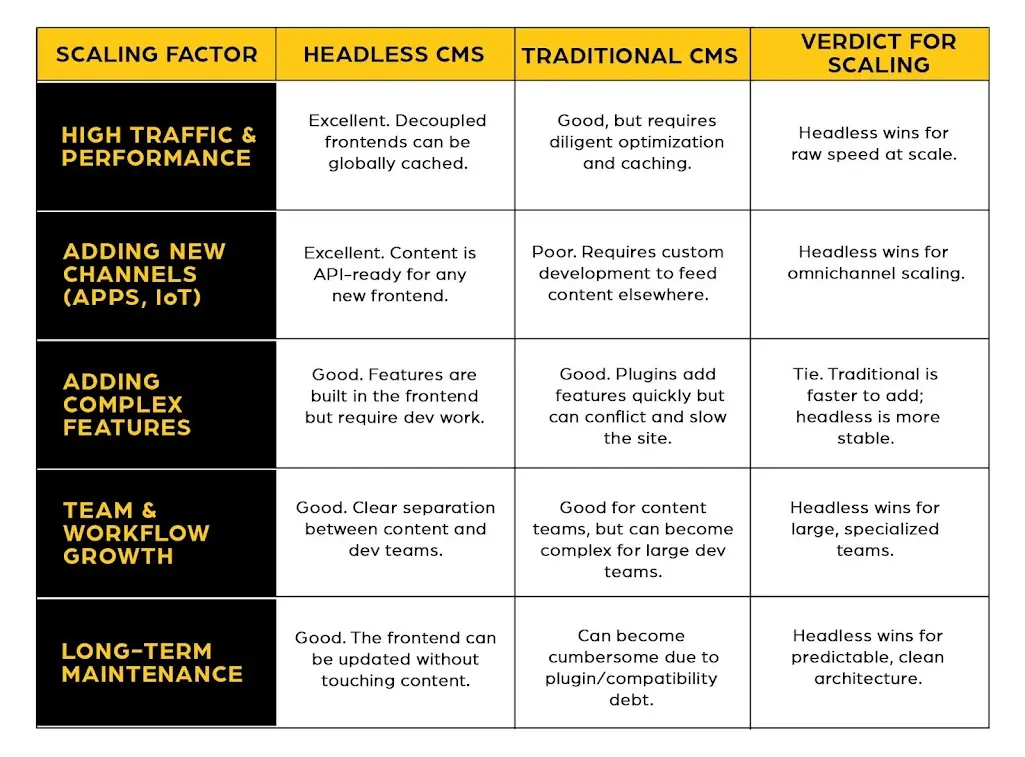
Scalability isn’t just about handling more traffic. It’s about growing your features, expanding to new platforms, and maintaining performance. Let’s compare them directly.
Making the Right Choice for 2026 and Beyond
So, which path should you choose? The answer lies not in which technology is “better,” but in which is better for your specific goals.
When a headless CMS is the Superior Choice
Consider headless if your project demands maximum flexibility and performance from the start.
- Omnichannel Strategy: YBrands operating across multiple platforms often rely on both a website development service and a mobile app development service. A headless CMS supports this structure by allowing the same content to serve websites, apps, and emerging channels without constant duplication or rework.
- Custom, High-Performance Frontends: You require a unique, app-like user interface built with modern JavaScript frameworks for maximum speed and user engagement.
- Large or Distributed Teams: You have specialized content editors and frontend developer teams who need to work independently without stepping on each other’s toes.
When a Traditional CMS Still Makes Perfect Sense
A traditional system is often the most efficient and sensible choice for straightforward web projects.
- Content-Driven Marketing Websites: Your primary goal is publishing blogs, articles, and service pages quickly and efficiently with a strong focus on editorial ease.
- Limited Technical Resources: You need a full-featured site without a large, ongoing development budget. The vast plugin ecosystem allows for extensive functionality out of the box.
- Rapid Deployment: You need to launch a professional, functional website in a very short timeframe to establish an online presence quickly.
Final Thoughts: It’s About Your Growth Trajectory
In 2026, scalability means being ready for whatever comes next. A traditional CMS scales well within the boundaries of a website, making it a robust choice for countless businesses. However, a headless CMS is inherently built to scale beyond the website, offering a foundation for a truly integrated digital ecosystem.
If your vision is a fast, future-proof presence that might encompass web apps, mobile experiences, and emerging platforms, then headless architecture is worth the investment. If your needs are firmly centered on a powerful, manageable, and content-rich website, a modern traditional CMS will serve you excellently.
The best next step is to assess your long-term goals. Reach out to our team for an honest conversation about your project’s needs and the best path to scale.
FAQs
1. Which CMS is better for long-term scalability in 2026?
Headless CMS usually scales better because it is built for change. As your website grows into apps, tools, or new platforms, you do not have to rebuild the content layer again and again.
2. Is a headless CMS always the right choice for every website?
Not really. If your website is simple and content-focused, a traditional CMS can still do the job well. Headless works best when growth and flexibility are part of the plan.
3. Can traditional CMS handle mobile apps and web apps?
It can, but it often feels stretched. Headless CMS is more comfortable when content needs to flow into mobile apps or custom web apps without duplication.
4. Does headless CMS cost more than traditional CMS?
The initial setup can cost more, but it often saves money long-term. You spend less time rebuilding, fixing performance issues, or restructuring content as your digital presence expands.
5. How do I know which CMS suits my business best?
Think about where your business is heading, not just where it is today. If you expect multiple platforms, faster updates, or custom experiences, headless CMS is worth serious consideration.
6. How can I contact 42works for CMS or website development guidance?
You can directly reach out to 42works if you want practical guidance on choosing between headless and traditional CMS. Just drop an email at contact@42works.net or call +91-9517770042 to speak with our team and discuss what actually fits your business goals.
What’s next
Integrate SEM Into Your Website Designing With Google’s New Tool