
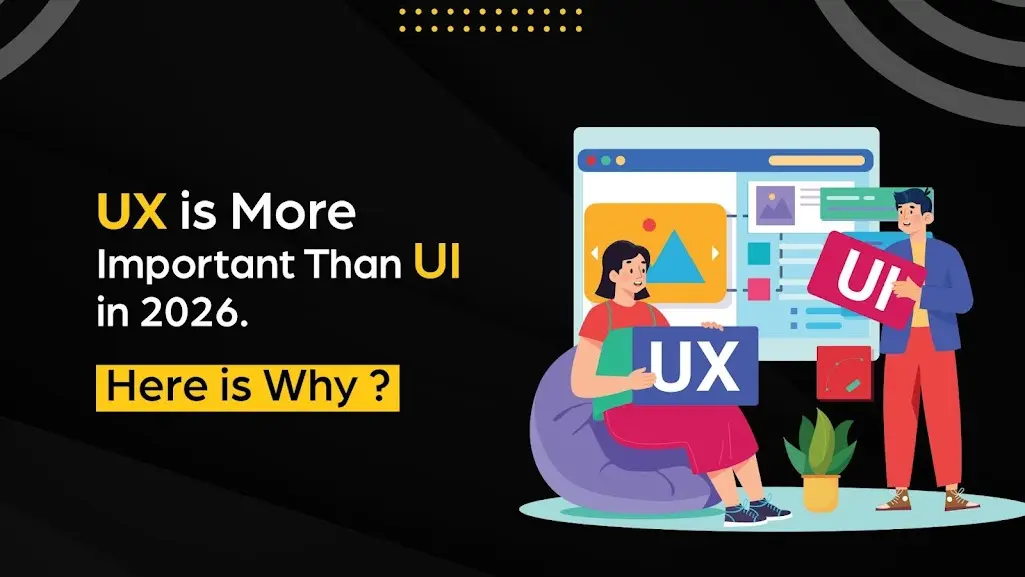
You’ve probably heard it a hundred times, “make it look good.” But here’s the thing: in 2026, looking good isn’t enough anymore. Users don’t just want pretty screens. They want experiences that feel effortless, logical, and even emotional. As UI/UX design trends in 2026 continue to evolve, one truth is becoming impossible to ignore: UX is now leading the conversation, and UI is playing second fiddle. If you’re building a product, app, or website and you’re spending more time on colors than on flows, you may already be losing users.
Explore our UI UX Design Services or Contact Us to talk about what your users actually need.
If you ask most people what good design looks like, they’ll point at colors, fonts, and animations. That’s UI. But if you ask them why they deleted an app, they’ll talk about confusion, friction, and frustration. That’s a UX failure, and in 2026, it’s the costlier mistake.
Quick Snapshot: UX vs UI in 2026
| Factor | UI (User Interface) | UX (User Experience) |
| Focus | Visual aesthetics | User journey and behavior |
| Measurable Impact | Bounce rate, scroll depth | Conversion rate, retention |
| AI Integration | Auto-generated components | Predictive personalization |
| Business Priority | Medium | High |
| User Perception | “It looks nice.” | “It just works.” |
| 2026 Trend Direction | Standardizing | Expanding rapidly |
The Shift Happening in UI/UX Design Trends 2026
The gap between UI and UX is widening, and businesses are finally noticing which side of that gap matters more. The UX design trends of the 2026 landscape are being reshaped by behavior-led design, AI personalization, and a sharp focus on accessibility. Here’s what that shift actually looks like in practice.
Why UX Has Taken the Driver’s Seat
Product teams, across industries, are repurposing budgets from visual polish toward user research and interaction design. That’s simple: users can overlook imperfect aesthetics but will never forgive broken journeys.
- Retention over attraction: If an app is great but has a convoluted onboarding process, it fails in the first 72 hours. A slick journey behind a simple-appearing app retained them for months.
- Cognitive load reduction: The best UX designers of 2026 are still obsessed with dropping the number of decisions that a user must make for a single screen.
- Emotional design: UX now considers how a user feels at every touchpoint, not just what they view.
- Accessibility-first thinking: Ensure inclusivity in design. It is already shaping significant decisions on major products that are compliant with WCAG 3.0.
- Zero-friction flows: From checkout to onboarding, eliminating friction is the number one UX priority this year.
What This Means for Your Product Strategy
If your team still considers UX as something that comes after UI in the pipeline, you need to overhaul your product roadmap. The top ui ux design firms of 2026 embed UX researchers into sprint teams on Day One, not at the end.
- Don’t Skip User stories: Don’t create wireframes.
- Do usability testing before you start visual design.
- Just like engineers treat technical debt, treat UX debt the same.
- Utilize session recordings and heatmaps to iterate on designs.
- Task completion rate, and not the visual appeal, is the ultimate measure of UX success
Real Talk: Why Businesses in Mohali Are Investing in UX Now More Than Ever
Brands partnering with agencies that offer website development services in Mohali and mobile app development services in Mohali are increasingly asking for UX audits before any new project kicks off. That’s a telling trend.
Here’s something that doesn’t get talked about enough: The future of UI/UX design with AI does not involve replacing designers. It’s about AI changing what designers need to design in the first place.
How AI Is Rewriting the Rules of UX Design Trends 2026
AI is not a tool anymore. It’s a design collaborator. The UX trends of 2026 are being defined by how well teams can integrate AI into the experience layer, not just the development layer. This is where UI and UX design services are evolving fastest.
AI-Powered Personalization and Adaptive UX
Adaptive UX means that the interface adapts according to who uses it and how. That sounds futuristic, but it’s already here. AI models built out of behavioral data are powering interfaces that evolve in response to user behavior.
- Behavioral AI: A broad categorization, it may include interfaces that learn from a user’s click pattern and scrolling behavior or interactions with the web page to understand what they are likely to need next.
- Dynamic content prioritization: Relevance-based algorithms ensure that only the most pertinent content for a user segment is surfaced, reducing discovery time.
- Conversational UX: With AI-powered chat interfaces and voice UX, mobile apps are moving away from menus.
- Predictive navigation: Rather than having users do the searching, the interface does it for them.
Micro-Interactions and Motion Design Powered by AI
Micro-interactions are those tiny moments: a button click animation, a loading state, and a success confirmation. In 2026, AI is generating and optimizing these moments based on what keeps users engaged the longest.
- AI tools now A/B test micro-interactions at scale automatically.
- Motion design is being used to guide attention, not just delight.
- Haptic feedback combined with motion creates multisensory UX.
- Voice UI and gesture UI are expanding beyond mobile into wearables.
Why the Best UI UX Design Teams Are Now Part AI, Part Human
The most effective UI/UX design services company setups in 2026 combine AI research tools with human empathy. AI tells you what users do. Human designers figure out why and design for both.
Read More: 10 E-Commerce UI UX Trends Transforming Online Shopping in 2025
Most teams get this wrong: they think UX research is a phase. In reality, it’s a practice. And in 2026, the teams that treat it like a practice are the ones shipping products that people actually use.
UX Research Is No Longer Optional in UI/UX Design
The UI/UX design conversation has shifted from “how does it look?” to “how do we know it works?” UX research methods are more accessible than ever, and the UX design trends of 2026 clearly show that data-informed design outperforms intuition-driven design every single time.
The Most Impactful UX Research Methods Right Now
Not all research is created equal. The methods that are making the biggest difference in 2026 are the ones that connect real human behavior to design decisions quickly and clearly.
- Moderated usability testing: Observing a real user struggle through real tasks will always be the most valuable research you can do.
- Card sorting and tree testing: They show how users organize information in their minds, signifying a lot about the core of information architecture.
- Diary studies: Longitudinal research that captures user behavior over days or weeks is becoming the norm for complex products.
- Eye-tracking heat maps: Now more affordable and widely used, these show exactly where attention lands on any screen.
- Unmoderated remote testing: Platforms like Maze and Useberry make it possible to run tests with hundreds of users in days, not months.
How Mobile App Development Is Being Shaped by UX Research
Mobile app development services in Mohali and across India are changing because of this shift. Apps are now designed around user mental models, not around what’s technically possible. The best mobile app development company teams embed UX researchers alongside developers from sprint one.
- Research findings are now treated as product requirements, not recommendations.
- Accessibility testing is part of every mobile app QA cycle.
- Gesture-based navigation is being user-tested before it’s built.
- Onboarding flow optimization is reducing drop-off rates by up to 40% in some cases.
The Hidden Cost of Skipping UX Research
Each hour spent on UX research saves an estimated five hours of rework in development. That’s not a guess; it’s an industry benchmark widely accepted by the Interaction Design Foundation.
Reference Article: ROI of User Research, Interaction Design Foundation
Design systems have moved beyond just consistency. In 2026, they’re going to be the connective tissue between UX strategy and UI execution, and they’re being constructed to scale with AI.
Design Systems: Where UX Strategy Meets UI Execution
AI-Integrated Design Systems, one of the defining UI/UX design trends for 2026, aren’t just component libraries. They’re living blueprints that take UX principles, accessibility guidelines, and interaction patterns to all the screens automatically.
What Makes a Great Design System in 2026
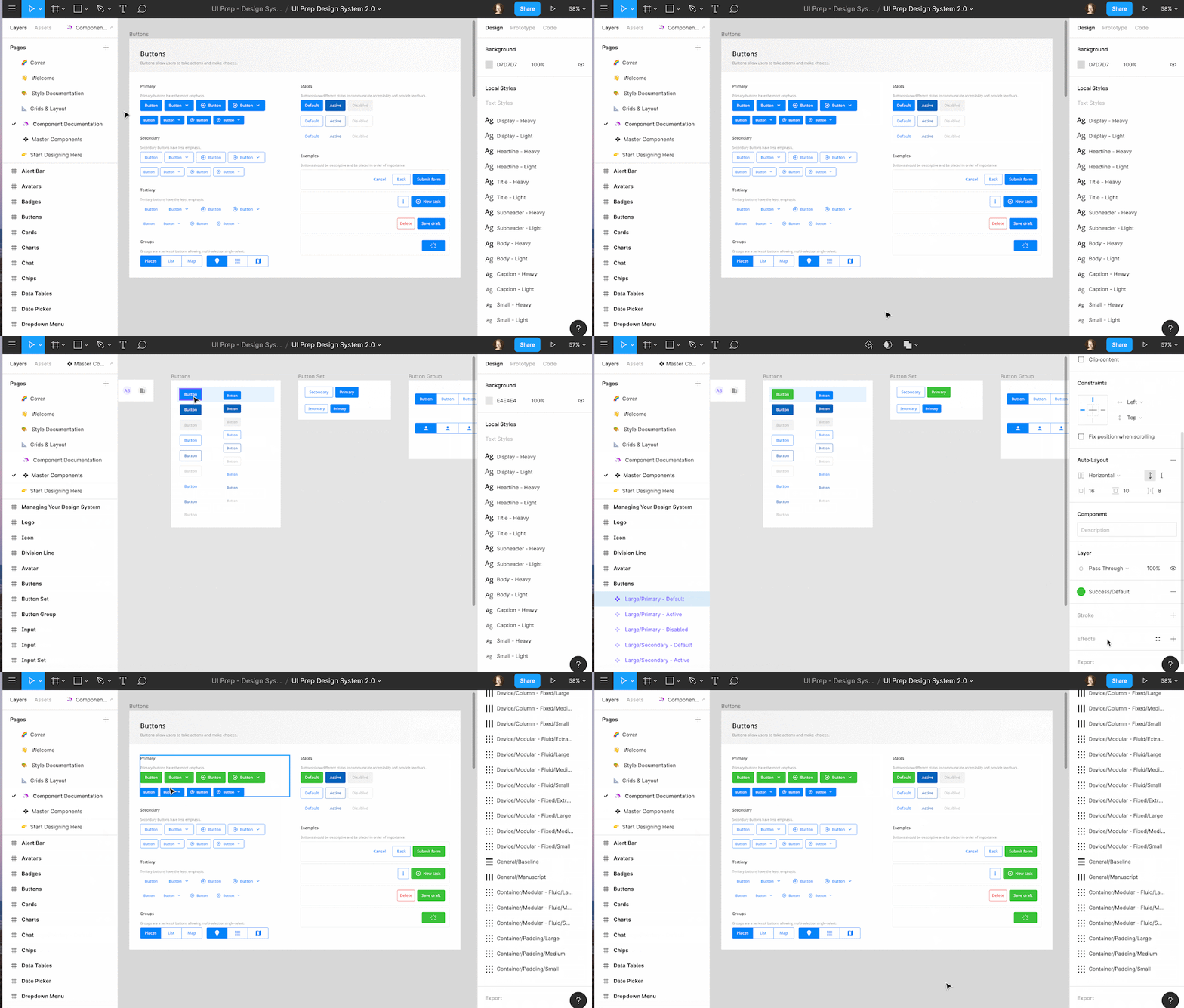
A compounded Design system takes the guesswork out of the design process. It means all designers and all developers are operating from a single source of truth, and that UX decisions pervade every component.
- Token-based design: Design tokens enable UX decisions (such as spacing and typography hierarchy) to propagate across entire products in mere seconds.
- Built-in accessibility: A great design system takes care of color contrast, keyboard navigation, and screen reader adherence from the start.
- Motion guidelines: Not just static components, the system defines how things move and why.
- Dark mode and adaptive theming: Handled at the system level, not case by case.
How the Best UI UX Design Company Uses Design Systems
The best UI/UX design company in India has teams that are building design systems that serve multiple platforms, like web, iOS, and Android, from a single source. This is especially valuable for businesses that need both website development and mobile app development services in Mohali under one roof.
- Cross-platform consistency reduces user confusion significantly.
- Developers spend less time interpreting design files.
- New features ship faster because components already exist.
- Brand identity stays consistent across every product touchpoint.
- QA cycles shorten because design system components are pre-tested.
Design Systems Are Now a Business Requirement, Not a Design Luxury
Organizations that invest in well-implemented design systems see quantifiable gains in development speed, design consistency, and product quality. Not having one in 2026 is a competitive disadvantage.
Reference Article: Design Systems Handbook, InVision
Accessibility isn’t a checkbox anymore. In 2026, it’s both a competitive advantage and a legal necessity in many regions. The most inclusive products are being built by the teams building the best products.
Accessibility Is the New Standard in UX Design Trends 2026
UI/UX design and disability accessibility have never been so closely linked. By designing for people with disabilities, you actually create better experiences for everyone. It’s not a coincidence; it’s the curb-cut effect at work.
What Inclusive UX Actually Looks Like
Inclusive design is in no way limited to including alt text on images. It’s a mindset that shapes every choice, such as colors, interaction methods, and content arrangements.
- WCAG 3.0 compliance: The new guidelines dramatically broaden the scope of accessibility requirements, and product teams are increasingly building toward compliance upfront.
- Cognitive accessibility: For users with ADHD, dyslexia, or cognitive fatigue. Focused copy, fewer distractions, and simpler flows.
- Motor accessibility: Mobile is the largest industry to give us a touch target for our fingers, gesture alternatives for functionality, and keyboard navigation with shortcut combos for everything.
- Voice-first design: With voice UI expanding in smart devices and mobile apps, coming up with clear conversational flows is becoming a core skill.
- Internationalization and localization: Designing for multiple languages and cultures is a part of the UX process, instead of an afterthought.
Accessibility in Mobile App Development Services
For companies providing web or mobile app development solutions, accessibility is becoming a client requirement. Enterprise clients are especially requiring WCAG compliance as a delivery condition. Mobile app development company teams that build accessibility in from the start avoid expensive retrofits later.
- iOS and Android both now flag accessibility issues natively in their developer tools.
- Screen reader compatibility is now tested in every mobile QA cycle.
- Accessible apps perform better in app store rankings due to lower uninstall rates.
- Global markets, including Europe, are enforcing digital accessibility legislation actively.
Accessibility Isn’t Charity; It’s Smart Business
The global disability market represents over 1 billion people with a collective spending power of more than $8 trillion. Designing accessibility is designing for a massive, underserved audience.
Reference Article: The Accessibility Advantage, WebAIM
Read More: How Custom Mobile App Development Will Grow Your Business in 2026 & Beyond
Let’s talk about something that’s quietly changing everything: the way users interact with interfaces is fundamentally different today than it was three years ago. And the future of UI/UX design with AI is accelerating that change even further.
The Behavioral Layer of UX: Why How It Feels Matters More Than How It Looks
This is the part of UI/UX design that doesn’t get talked about enough in most design blogs. Emotion is not a soft, fluffy concept in UX. It’s a measurable factor that directly impacts conversion, retention, and word-of-mouth. The most advanced UI/UX design services in 2026 are factoring emotional design into every user journey.
How Behavioral UX Design Is Reshaping Product Thinking
Users don’t describe their experience with products in terms of pixels and padding. They describe it in terms of feelings. “It felt clunky.” “I felt stupid using it.” “It just felt right.” These are UX outcomes.
- Delight moments: Intentionally designed moments of unexpected joy in the user journey, a playful empty state, and a celebration animation after completing a task increase emotional attachment to a product.
- Trust signals: UX design that makes users feel safe and informed reduces anxiety and increases conversion, especially in fintech and health apps.
- Error empathy: The way your product handles user mistakes defines how users feel about your brand more than anything else.
- Transparency UX: Users in 2026 demand to know how their data is being used, and UX that makes this clear builds enormous trust.
Behavior-Led UX for Mobile App and Web Products
Whether you are working with a UI/UX design service company or building in-house, understanding the emotional arc of your user journey is now a baseline expectation. Mobile app or website development services teams that embed emotional design thinking into their sprints are shipping products with measurably higher user satisfaction scores.
- Emotional design audits are now offered as standalone services by leading agencies.
- NPS (Net Promoter Score) is directly tied to emotional UX quality.
- App reviews on the Play Store and App Store are essentially emotional UX feedback at scale.
- Onboarding experiences that create emotional investment in the first session dramatically improve 30-day retention.
In 2026, Users Don’t Just Use Products, They Feel Them
The most successful digital products of 2026 are not the flashiest. They’re the ones that make users feel capable, confident, and cared for. That’s the real promise of great UI/UX design.
Conclusion: UX Is Not a Feature. It’s the Foundation.
Here’s the bottom line: in 2026, the most beautiful interface in the world will fail if the experience underneath it is broken. UX is the architecture. UI is the paint. You can paint a crumbling wall, but it’s still going to crumble.
As UI/UX trends in 2026 continue to push toward AI-driven personalization, inclusive design, and emotion-aware interfaces, the gap between surface-level visual design and deep experience design will only grow wider. The businesses that understand this and invest accordingly are the ones that will keep their users, grow their conversion rates, and build products people genuinely love.
If you’re ready to move beyond pretty screens and start building experiences that actually work, 42Works is here to help. We offer end-to-end UI and UX design services, website development services in Mohali, and mobile app development services in Mohali that are built around real user behavior, not assumptions.
Get in touch with us today; let’s build something your users will actually love.
Reference Articles
- Nielsen Norman Group, UX Research and Design Resources
- Interaction Design Foundation, UX Learning Platform
- ROI of User Research, Interaction Design Foundation
- Design Systems Handbook, InVision
Tags
UX Design 2026 | UI UX Trends | Future of Design with AI | Mobile App Development | Accessibility in UX
FAQs
- What’s the actual difference between UI and UX, and why does it matter?
UI is what the interface looks like, including colors, buttons, and typography. UX is how the whole experience feels and functions from the user’s perspective. In 2026, UX matters more because users make decisions based on how easy something is to use, not just how it looks.
- Why is UX more important than UI in 2026 specifically?
Because user expectations have skyrocketed. AI-powered apps and competitive markets have made users less patient with friction. A beautiful app that confuses users gets uninstalled faster than a simple app that just works.
- What are the biggest UX design trends in 2026?
The biggest ones right now are AI-driven personalization, voice- and gesture-based navigation, accessibility-first design, emotional UX, and design systems that span multiple platforms.
- How is AI changing UX design?
AI is enabling adaptive interfaces that change based on user behavior, automating repetitive design tasks, powering conversational UX, and making large-scale user research faster and more affordable.
- Is UI design becoming irrelevant?
Not at all. UI is still important, but it just plays a supporting role to UX now. Think of UX as the strategy and UI as the execution. Both matter, but the order of priority has shifted.
- What does “emotional design” mean in UX?
It means deliberately designing moments in a product that make users feel something positive, like confidence, delight, trust, or relief. These emotional moments increase engagement and loyalty more than aesthetics do.
- How much does good UX design actually improve conversion rates?
Research consistently shows that every dollar invested in UX returns up to $100 in improved conversion, reduced support costs, and faster development. UX improvements of even 10-15% in task completion rates can significantly impact revenue.
- What’s the role of accessibility in UX design trends in 2026?
It’s central. WCAG 3.0 is now actively influencing product requirements. Designing inclusively isn’t just ethical; it opens your product to a much larger user base and, in many regions, is legally required.
- How do I know if my current UX is broken?
Look at your drop-off rates, your support tickets, your app store reviews, and your task completion rates. If users can’t complete core tasks without help or confusion, your UX needs work.
- What’s the difference between a UX audit and a redesign?
A UX audit identifies what’s broken and why, using data and user testing. A redesign is the fix. You should always audit before you redesign; otherwise, you’re guessing at solutions to problems you haven’t properly identified.
- Should small businesses invest in UX design or save money and just focus on UI? Small businesses often can’t afford to lose users to poor experiences. Even basic UX improvements, clearer navigation, simpler forms, and better onboarding have an outsized impact for smaller products and budgets.
- What are some low-competition keywords related to UX design that still get decent traffic?
Terms like “UX design for mobile apps,” “user flow design tips,” “UX research methods for startups,” “how to improve app onboarding UX,” and “best UI/UX design company in India” tend to have decent search intent with manageable competition.
- How do mobile app development services factor in UX design?
The best mobile app development services in Mohali and across India now treat UX as integral to development, not separate from it. UX flows are defined before a single line of code is written, and usability testing happens throughout the development cycle, not just at the end.
- What makes a design system worth investing in for a growing startup?
A design system saves time at scale. When your product is small, consistency is easy to maintain manually. As you grow, without a system, UI inconsistency and UX fragmentation become massive, expensive problems to fix.
- How can I reach 42Works to discuss UX or mobile app development services?
Super easy. You can email the 42Works team directly at contact@42works.net or give us a call at +91-9517770042. We work with businesses on everything from UX audits and UI/UX design services to full-scale web and mobile app development. The team is pretty responsive and happy to jump on a discovery call.